How to Find Official K-pop Accounts: Links, Badges and Fan Sources
Trace an artist’s official links, understand what X and YouTube badges mean, and keep fan translations and fancams attached to their original sources.
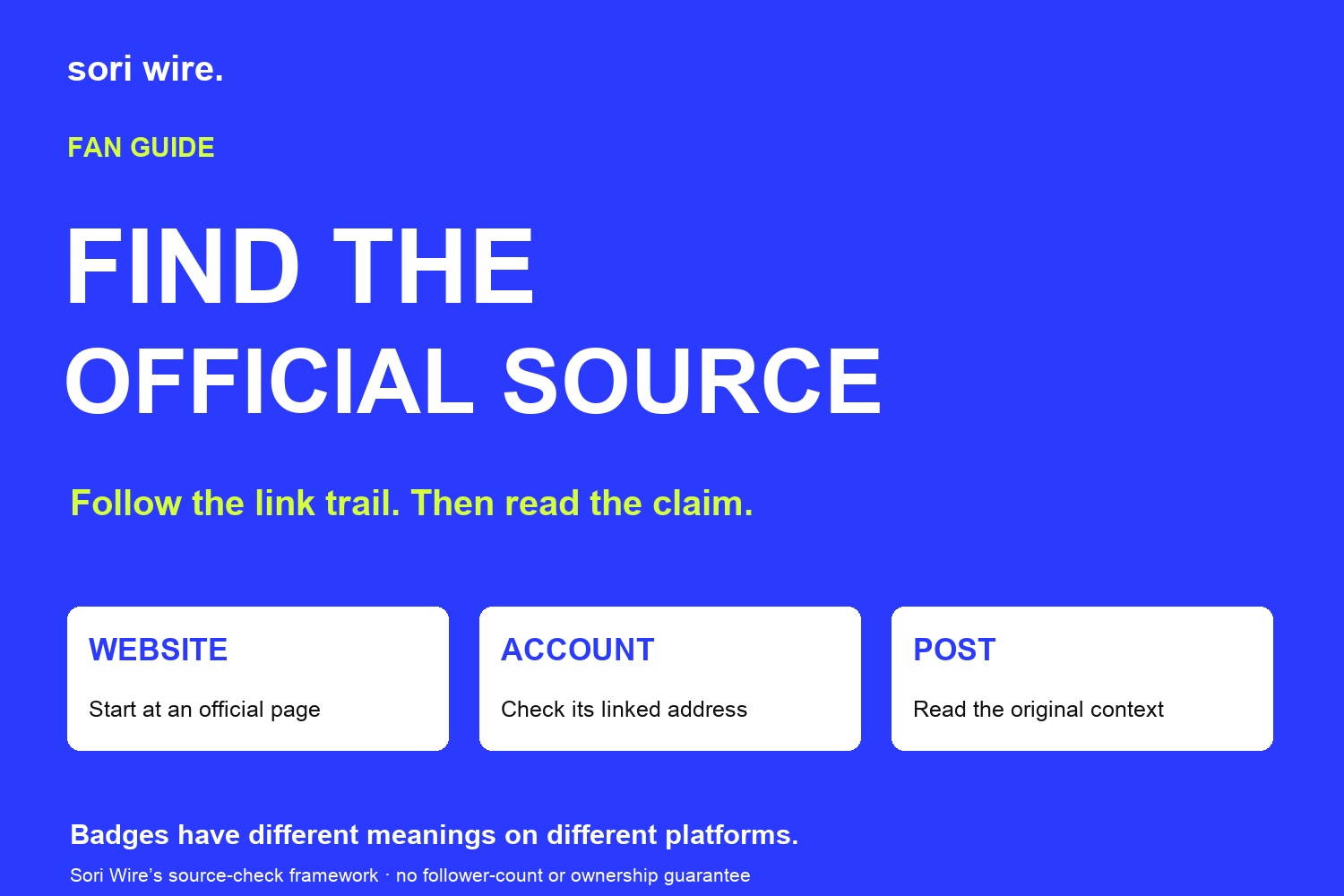
A comeback teaser lands in your timeline, a translator explains the caption, and a fancam appears before you have finished breakfast. All three can be worth seeing. They do not necessarily come from the same kind of source, and a familiar profile picture does not tell you who controls the account. Finding the official post is about keeping that distinction clear without losing the fun of following your favourites. This guide offers a practical reading workflow: start from a known artist website, follow its actual outgoing links, and keep the original post attached to whatever you share. We use TWS’s official Japan profile as a link example and explain why X and YouTube badges need different interpretations. The diagrams are our own reference tools, not screenshots of a live verification test. This is not a directory that certifies every K-pop account, and it makes no claim that an account will remain unchanged forever.
At a glance
- Start here
- Use a known official website’s actual outgoing link, and save the confirming page.
- Badges
- X Premium checks and YouTube channel verification have different definitions.
- Source roles
- Keep artist announcements, organizer posts, fan translations and recordings distinct.
- Limits
- A dated link observation is not permanent ownership certification or a media license.
In this guide
Start with an official website, not the most familiar avatar
TWS’s Japan official profile provides a useful starting point. When checked for this guide, it linked to an official website and several platforms, with Global X and Japan X labelled separately. We observed those outgoing links on the profile itself; we did not independently audit every destination or certify the future ownership of each account. A link on a dated official page is evidence you can inspect, rather than a guess based on how convincing a profile looks.
For your own reading list, save the page that supplies the link as well as the destination. That makes the connection easy to revisit if a handle changes or a new regional account appears. We suggest recording a short note such as “linked from the artist profile” instead of the vague label “looks official.” If you cannot establish that connection yet, leave the account unconfirmed. Unconfirmed means your evidence is incomplete; it is not an accusation against the person running the page.
Compare the address and handle, not only the display name
YouTube describes handles as unique identifiers that begin with @ and are distinct from channel names. Its help also explains that a shared channel link can use a channel ID instead of a handle, particularly with internationalized names. Seeing two URL formats is therefore not, by itself, proof that you have found two different channels. Read the actual destination before judging the address from a screenshot.
Our suggested check is simple: follow the official page’s link, open the account, then copy the address from that destination into your source note. Compare it with the link you were originally sent. If the match is unclear, keep both records and return to the official entry point. Do not create a universal spelling rule that rejects punctuation, local-language text or regional suffixes. A fan can also choose an artist-related display name; that name alone should not become your evidence that the artist operates the account.
An X blue check and YouTube verification answer different questions
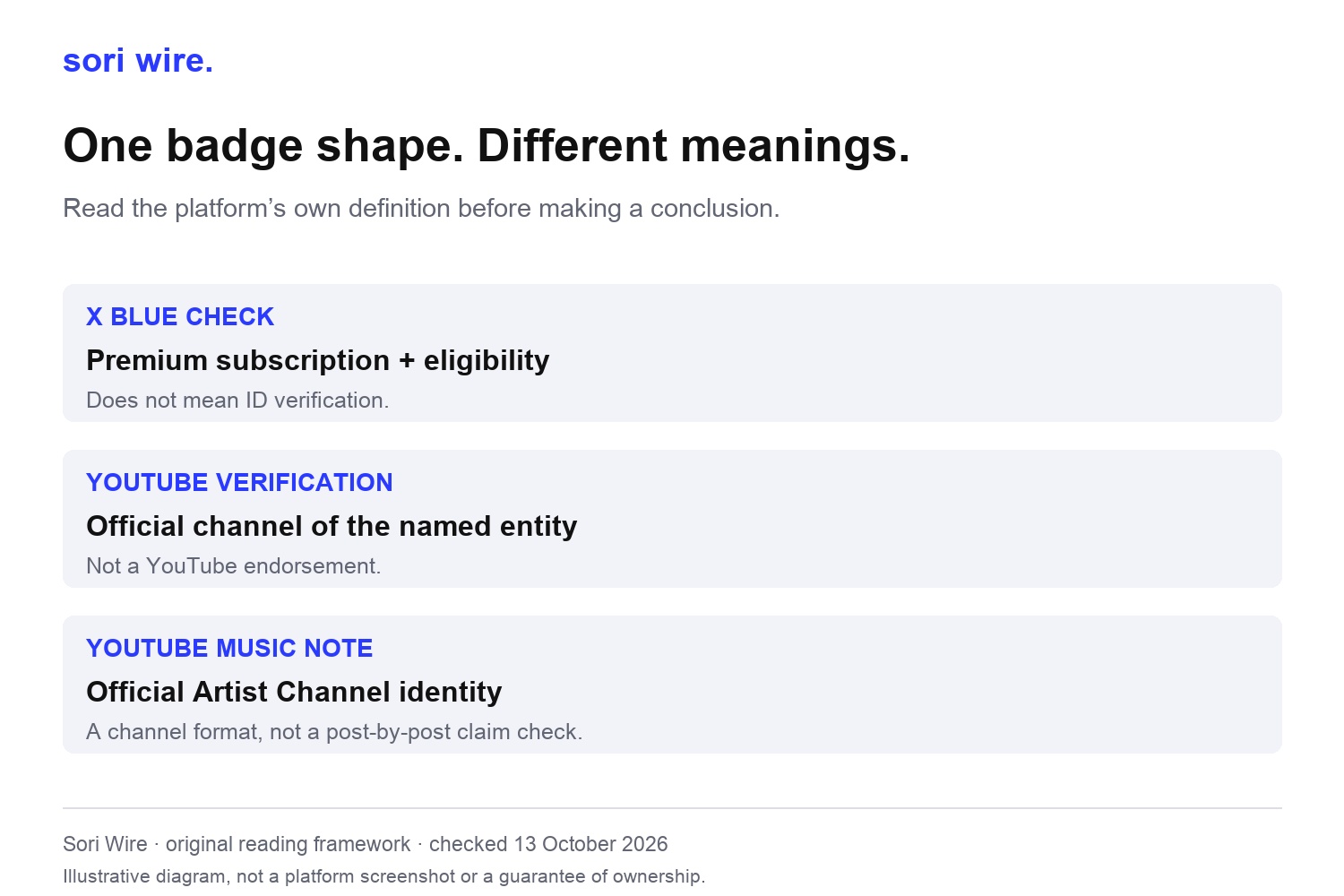
X’s current help says its blue check indicates an active Premium subscription and eligibility, not ID verification. YouTube’s verification help gives a different definition: a verified channel is the official channel of the creator, artist, company or public figure it represents. YouTube also says that verification is not its endorsement. Meanwhile, YouTube for Artists identifies the music-note icon with an Official Artist Channel. These labels should not be collapsed into a single promise that every statement beside them is correct.
Use the comparison graphic as a reading aid, then return to the platform’s current explanation when you need detail. A badge can contribute evidence, but it does not replace checking whose channel it is and which original post supports the story. We have not checked the present badge status of any named artist account in this guide. We also do not treat the absence of a badge as proof that a newly discovered account is fake.
Keep global, regional and member accounts in separate slots
The Global X and Japan X labels on TWS’s official profile demonstrate why region belongs in a source record. The page’s Global X link points to the TWS_PLEDIS account through a twitter.com address. That dated outgoing link observation does not establish that every similarly named account is official or that a regional announcement applies worldwide.
Our reading list would keep a group’s main channel, a Japan-specific channel and any independently confirmed member account as separate entries. Attach the source that establishes each connection, rather than copying one account’s official status onto the others. When a post concerns a local shop, broadcast or event, preserve the region stated in the post. If it does not give a wider release plan, do not add one. This helps an overseas fan understand which information is relevant without assuming that different accounts should always publish identical content or that silence on one channel cancels another channel’s announcement.
An official artist photograph is not proof of an account’s ownership

TWICE’s official JYP profile explicitly labels the NAYEON portrait used here. That page provides the name-to-image connection; we did not identify her by guessing from facial appearance. We use the unchanged picture as a representative artist illustration, not as evidence of a personal social account, a current appearance or endorsement of this guide.
The distinction matters when checking profiles. An image can help you recognize the subject, but the useful question is where the account link came from. Our recommendation is to write the photograph’s source and the account’s source as two separate pieces of information. A profile that uses a recognizable image still needs a traceable ownership connection. Equally, an official page using a new promotional photo should not be dismissed just because it looks different from the one you saved. Image credit explains origin; it does not establish a reuse license or show who is currently operating an unrelated account.
Do not confuse a music catalogue with a personally managed upload feed
YouTube explains that an Official Artist Channel brings an artist’s subscribers and music content from different channels together. Its description includes Topic, Vevo where available, and existing artist-channel audiences. That structure is useful for listening, but it should not be turned into a claim that the artist personally uploaded or wrote every item you encounter.
For a source note, distinguish the channel page from the specific video and the claim you are trying to verify. If you want the announcement of a release date, keep the dated announcement itself rather than substituting a catalogue page that happens to contain the song. If you want to watch a performance, save the actual video URL and its uploader. Our advice is about making your bookmarks answer the right question. It does not reject catalogue content as worthless or infer that a Topic channel is a fan impersonator simply because its structure differs from a conventional upload feed.
Fan translators and fancam creators can be useful without becoming official spokespeople
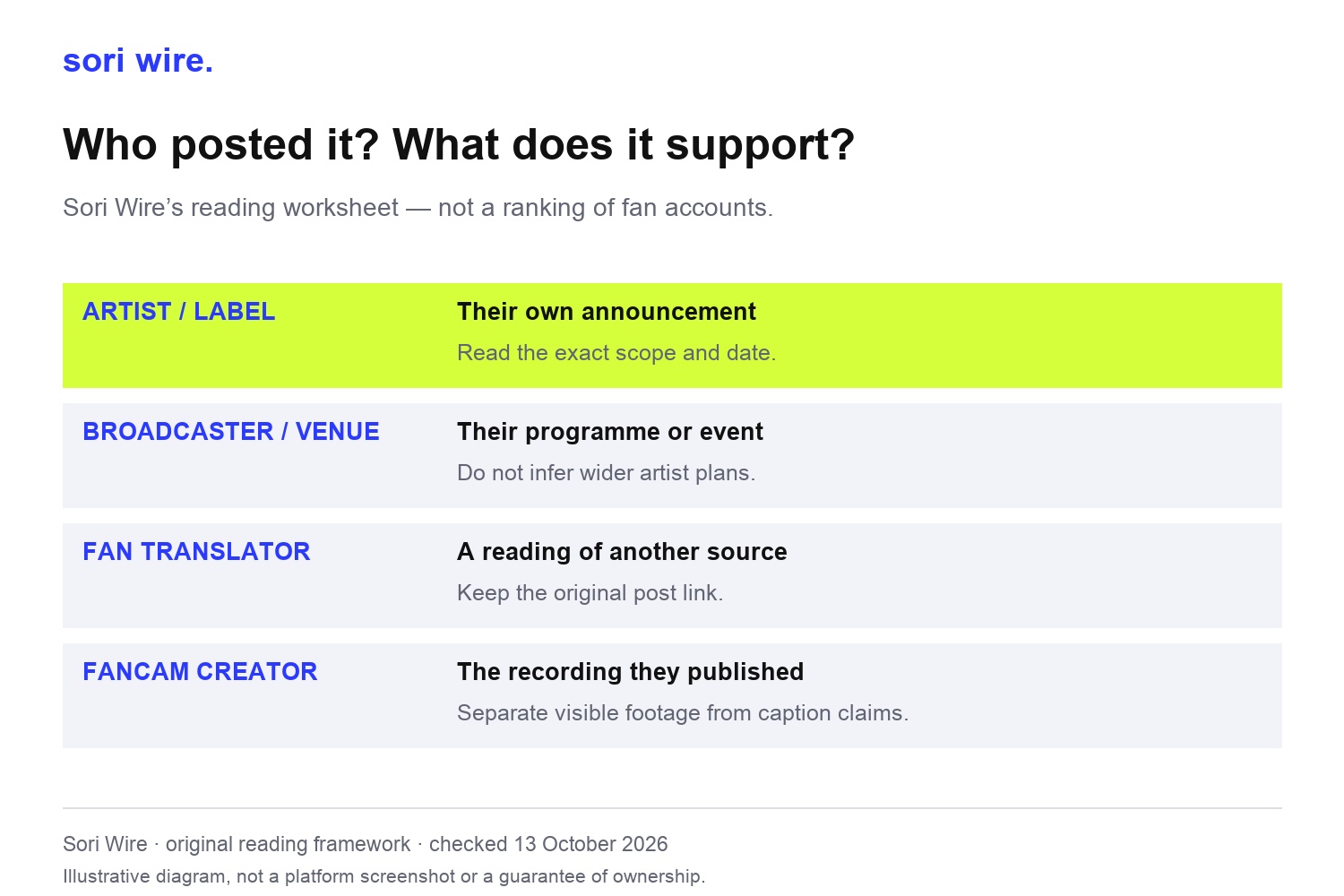
A translator can help you understand a caption, and a fancam creator can share a particular view of a performance. Our source-role worksheet separates those contributions from an artist’s own announcement. It is an editorial framework for reading, not a platform policy or a ranking of named fan accounts. We have not investigated any account’s accuracy, motives or right to film through this guide.
Keep the creator’s original link when sharing their work. For a translation, also retain the artist or organizer post being translated so readers can see the context. For a fancam, describe what the recording and its accompanying source actually support; a clip is not permission to add an unconfirmed award result, schedule or relationship. You do not have to stop enjoying fan-made content to make those distinctions. A clear attribution can celebrate the person who made it while leaving an official announcement in the hands of the party responsible for issuing one.
A correctly linked account can still be read out of context
After locating the source, write down the specific claim you want to share. Is it announcing an event, reposting another account, showing a behind-the-scenes moment or quoting a previous message? Our method keeps those questions separate from account identity. Finding a link on the official site tells you why you are looking at that account; it does not fill in details absent from the post.
Read the caption, date and linked destination together. A promotional phrase should not quietly become an attendance claim, and an old post should not become a new announcement because it was reshared today. If the post supplies only a photograph and a short caption, keep your description similarly narrow. Save the source URL beside the detail rather than constructing a broader story from the image. This is our suggested reading discipline, not a claim that every official post follows the same format or that we have tested the history of every account mentioned.
Treat a changed handle as a reason to recheck, not a reason to guess
YouTube says that changing a verified channel’s name requires reapplication, while changing its handle does not remove the verification badge. That difference is another reason not to treat a display name, handle and verification status as interchangeable fields. The rule is specific to YouTube; we do not apply it to every other platform.
When something in your own bookmark changes, return to the current official entry point and compare the destination again. Retain your previous note with its observation date instead of erasing the history. If the available evidence does not explain the change, mark the connection as needing another check. We do not recommend announcing a takeover, departure or fraudulent account simply because a handle differs from an old screenshot. Nor does a preserved link guarantee that control of the destination has never changed. Your note should describe the connection you observed and when you observed it, leaving unsupported explanations out.
Use a known entry point when an unexpected message asks you to act
The FTC’s phishing guidance recommends contacting a company through a website or number you already know is genuine, rather than using contact details in an unexpected message. Applied narrowly to fandom browsing, that means returning to the artist or organizer’s known page when a message claims there is a new action you must take. This article does not investigate a particular message or certify any giveaway, ticket offer or login form.
Keep the public source check separate from private account access. You can compare a website’s outgoing link without posting passwords or sign-in codes in a fan conversation. If a message creates pressure, pause and look for the corresponding announcement through the known route. A recognizable photograph or a pasted logo is not enough reason to follow instructions. For an actual account-security concern, use the platform’s official help; our source worksheet is a reading tool, not a security audit or a promise that it catches every deceptive message.
Build a small source notebook you can actually maintain
Our suggested notebook has five fields: subject, source role, platform address, confirming page and date checked. Keep a group and a member distinct, and add a region when the source itself identifies one. The table below is a blank framework, not a completed directory. It deliberately includes an unconfirmed state so that uncertainty is visible instead of being disguised as official status.
Start with the artists you follow most closely rather than filling a huge list in one sitting. When a link changes, revisit the confirming page and update the dated observation. When sharing a story, attach the particular post in addition to the account bookmark. That gives another reader enough context to follow your reasoning. Avoid using follower counts, visual polish or an enthusiastic comment section as substitutes for the link trail. Those features may explain why an account feels familiar, but our notebook is meant to preserve inspectable sources, not to predict which account deserves your attention.
Read the chart as a table
| Record field | What to save |
|---|---|
| Subject | Group, member or other named entity |
| Role and region | Artist / organizer / translator / recording creator; stated region |
| Destination | Exact account address; specific post kept separately |
| Confirming source | Official page or announcement linking this destination |
| Checked date and status | Dated observation; confirmed connection or still unconfirmed |
How this guide was made
Official artist pages, X and YouTube help, YouTube for Artists and FTC guidance were checked on October 13, 2026. TWS outgoing links are dated page observations, not an audit of every linked account. NAYEON’s photograph is linked and explicitly named on TWICE’s official profile; it is representative, unchanged and not an account screenshot. Sori Wire created three original reading diagrams and the source notebook. No named fan account was investigated or rated, no present artist badge status was asserted, and no follower statistics, affiliation guarantees or reuse licenses were invented.