Japan K-pop Ticket Lotteries: Check the Sales Route Before You Apply
Separate residence, fan-club eligibility, seller accounts, payment and ticket receipt—with official Lawson and PIA guidance and a closed TWICE Japan round as a historical example.
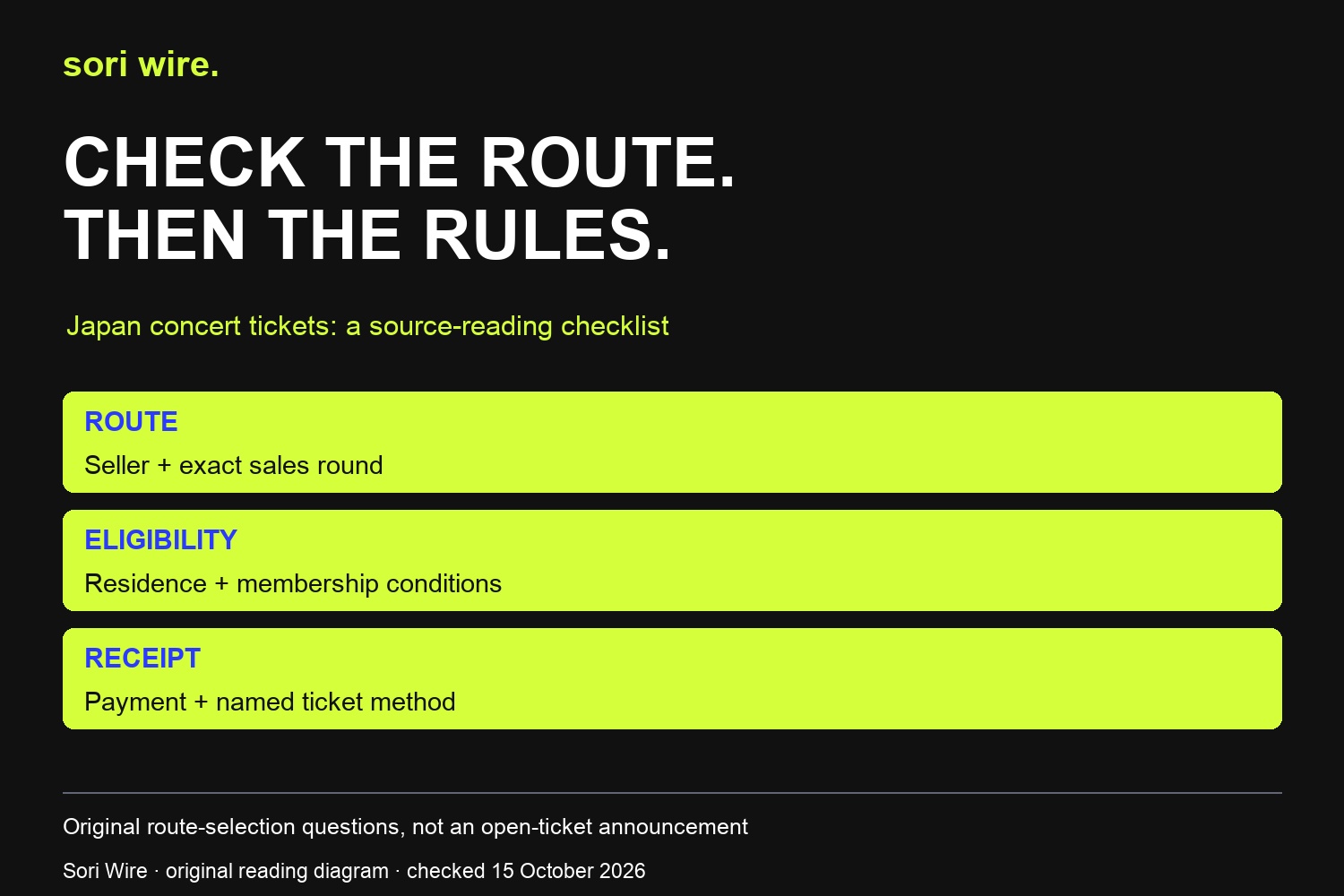
A Japanese concert announcement can look accessible until you reach the ticket link. The language changes, a different membership appears and the page asks about a delivery method you have never used. The useful starting point is to identify the exact sales route before interpreting its rules. This guide compares official Lawson Ticket and PIA information with a closed TWICE Japan fan-club round, then provides a practical route-check worksheet. It does not announce an open lottery, promise overseas eligibility or test a checkout on your behalf. All instructions remain specific to the service or historical round they describe.
At a glance
- Route first
- Identify the seller and named sales round; presale does not always mean lottery.
- Eligibility
- A foreign-user help page does not remove a domestic residence requirement.
- Separate accounts
- Fan-club qualification and ticket-service registration can be different checks.
- Scope
- The TWICE 2025 round is closed; this article does not announce available tickets.
In this guide
Choose the actual sales route before translating the rules
Begin with the concert organiser’s official ticket link. Record the seller, the named sales round and whether the page describes a lottery or a purchase. Our suggested route card keeps those three fields together with the original URL. A platform logo alone is not enough: a provider can offer different services, while an English information page may describe a separate route from the domestic page linked by a particular event.
Lawson’s official non-Japanese-user FAQ says advance sales can operate either by order of arrival or by lottery. PIA’s international-sale information directs readers to the particular purchase page for the sales period and limits. These examples show why the word presale does not tell you the selection method. Read the round’s own description rather than assuming that every early sale is a draw or that every translated page opens the same inventory.
Save a short route description you could explain to a friend: this is the official link for this round, these are the applicant conditions, and these details remain unresolved. That is a reading aid, not a claim that the route is available to you. If the organiser links more than one route, compare their stated scope individually. Do not merge the most convenient condition from each page into a process no seller actually offers.
Nationality and residence are different eligibility questions
The heading for foreign users is not a blanket permission to join every domestic sale. Lawson’s FAQ says its presale membership registration is available only to people residing in Japan. It also notes that some general sales require membership. Keep this provider statement attached to the route it describes, rather than extending it to every ticket service or every event held in Japan.
For your own eligibility note, separate nationality, current residence, fan-club status and ticket-service registration. They describe different facts about an applicant. An English-language page can help you read the terms without changing them. Likewise, a foreign passport does not answer a residence question, and a membership in an artist’s international community does not establish eligibility for a particular Japanese fan-club round. Check the labels the actual notice uses.
If a requirement does not fit your circumstances, look for a separately announced official route or ask the specified support contact a precise question. Do not substitute a borrowed address, another person’s identity or a workaround from a forum for a stated qualification. Our recommendation is to stop at an unresolved field rather than building a travel plan around an assumption. This article does not assess a named reader’s residency or verify account acceptance.
Read fan-club and ticket accounts as separate requirements

TWICE’s official Japan tour page provides a useful historical case. Its closed 2025 ONCE JAPAN and overseas-resident ONCE JAPAN round names applicant fan-club eligibility and separately requires ticket board registration. The round says companions need registration at ticket issuance. This is an example of two account systems serving different purposes, not a current invitation to enter that round or a general exemption for companions.
Read the title immediately above a condition. The same long tour page contains several rounds and a separate additional-show link. Our worksheet deliberately avoids reproducing an overall timeline assembled from those sections. An applicant rule under one heading should not be carried into another round simply because the artist, tour name or seller is the same. The historical case is valuable precisely because it shows why the surrounding heading matters.
For your current event, make separate rows for the applicant and companion, then record each stated account requirement and the stage when it must be fulfilled. If general wording and a round-specific paragraph appear to differ, retain both source passages and seek clarification from that event’s support route. Do not quietly choose the easier statement. A completed fan-club registration is not itself a ticket, and this guide does not claim to have tested the registration or issuance flow.
An application, a result and an issued ticket are different states
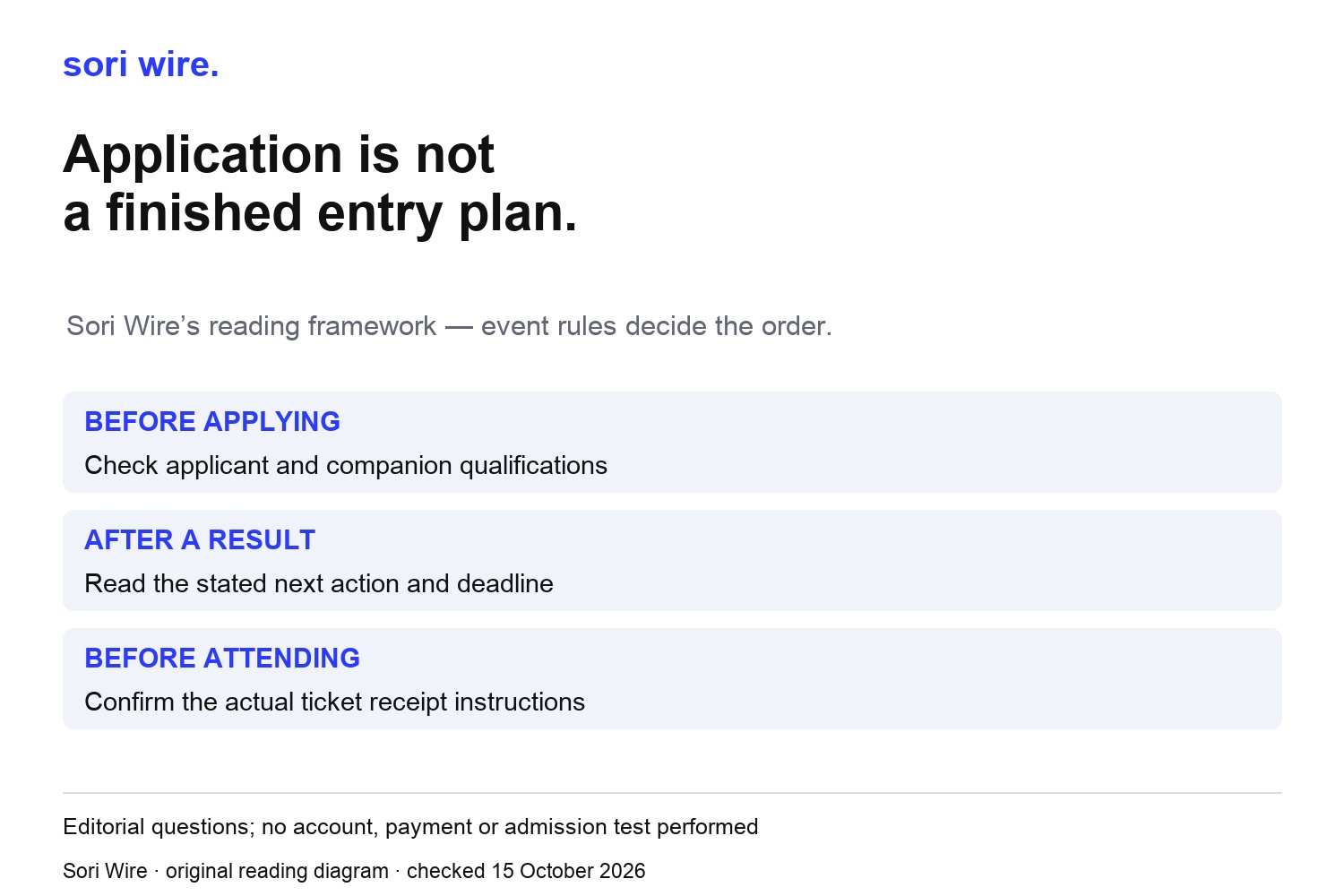
Our original workflow separates route eligibility, application, result, payment where required and receipt. It is a checklist for reading a notice, not a universal promise that every seller performs those steps in that order. A lottery application is a request to be considered. Keep the seller’s actual status wording in your note instead of labelling every successful form submission ticket confirmed.
Lawson’s FAQ directs users to their application history when an email is missing or a reservation outcome is unclear. That gives you a stronger starting point than guessing from an inbox. Use the history page belonging to the route you actually used. An email, a notification and an account status may serve different roles; read what the seller identifies as the confirmation rather than choosing whichever message arrived first.
Before acting on a result, find the next instruction in that notice: a payment deadline, a receipt procedure or another explicitly described step. A friend’s successful purchase on a different route does not establish your own result. Keep any unresolved outcome separate from a failed application, and avoid a second transaction made only to see whether the first one worked. This guide offers a source-reading method; it does not inspect a private order or determine whether anyone has a valid ticket.
Check a usable payment method before relying on a win
Payment conditions are part of route selection. Lawson’s FAQ warns that overseas-issued cards may not work and that store payment requires payment in Japan by the applicable deadline. PIA’s international-sale page names credit-card payment. These are provider-specific observations, not a guarantee that a particular card, event or checkout will accept a reader’s transaction.
Our recommendation is to write the accepted method and the precise deadline from the relevant sale before you commit to an application. If you are outside Japan, consider whether the method can actually be completed from your circumstances. Do not use a generic payment period from a help page when the event states a different one. Where fees or limits are deferred to the purchase page, leave your comparison incomplete until that page provides them.
The worksheet does not estimate exchange rates, card fees or the cost of travelling to make a payment. Those would require different current inputs. It also does not recommend spending money on a membership solely because you hope it will unlock a route. First establish the stated qualification and the sale’s actual conditions. If support cannot resolve a payment question, record the uncertainty rather than presenting a speculative workaround as advice another fan can safely follow.
Receiving the ticket deserves its own route check
PIA’s international-sale information describes several delivery options, including Japan store pickup, will call and a browser-based MOALA ticket. The MOALA description requires a smartphone and internet connection. These are options listed by the service; the event’s page must establish which applies to a particular sale. Do not combine them into a promise that every purchaser can choose a paper ticket or receive entry through any smartphone.
The historical TWICE page, by contrast, identifies ticket board QR issuance. That distinction illustrates why an application route and a receipt route belong on the same note. Getting to an application page is only part of your plan. You also need to understand the method for the named ticket, the relevant account and any companion instructions. This guide does not test either provider’s device behaviour or guarantee that a screenshot is accepted at a venue.
A useful personal checklist asks what the ticket will be, where it becomes available and what the official guide says to bring or use. Keep those answers tied to the event and provider. If your phone, account or travel timing does not match the stated process, resolve the mismatch before treating the plan as complete. Do not infer a delivery method from a previous tour or a promotional image that happens to show a QR code.
Keep identity and companion instructions attached to the event
A provider can describe identity verification as part of a collection method without giving the full admission rules for every concert. PIA’s will-call description mentions an identity check. The TWICE tour notice says the applicant and correctly distributed companion should attend. Those statements are useful within their own scope; they do not establish a universal accepted-document list or transfer policy for all Japanese shows.
For a current event, copy the exact document and companion instructions from the official notice rather than relying on a general concert packing list. If the name format or document type is unclear, ask the designated support route about that field. You do not need to send private identity documents to a fan account to obtain a translation. A question about the written condition can be phrased without publishing your document number or other sensitive details.
Our companion worksheet keeps the people and their required actions separate. It does not assume that the person paying for an order can attend in place of someone else or that an unused ticket can be passed to a friend. Check the stated distribution and attendance rules. Where you cannot verify them, preserve the question in your note. The article does not provide legal advice or certify an individual’s admission eligibility.
Make a route card you can update before applying
Bring the checks together on one page: organiser link, named seller and route, applicant qualification, companion requirements, selection method, result location, payment condition and receipt method. Our diagram is intentionally a blank sequence of questions rather than a map of one guaranteed purchase. You can use it to identify a missing field without filling that field with a fan’s experience from another concert.
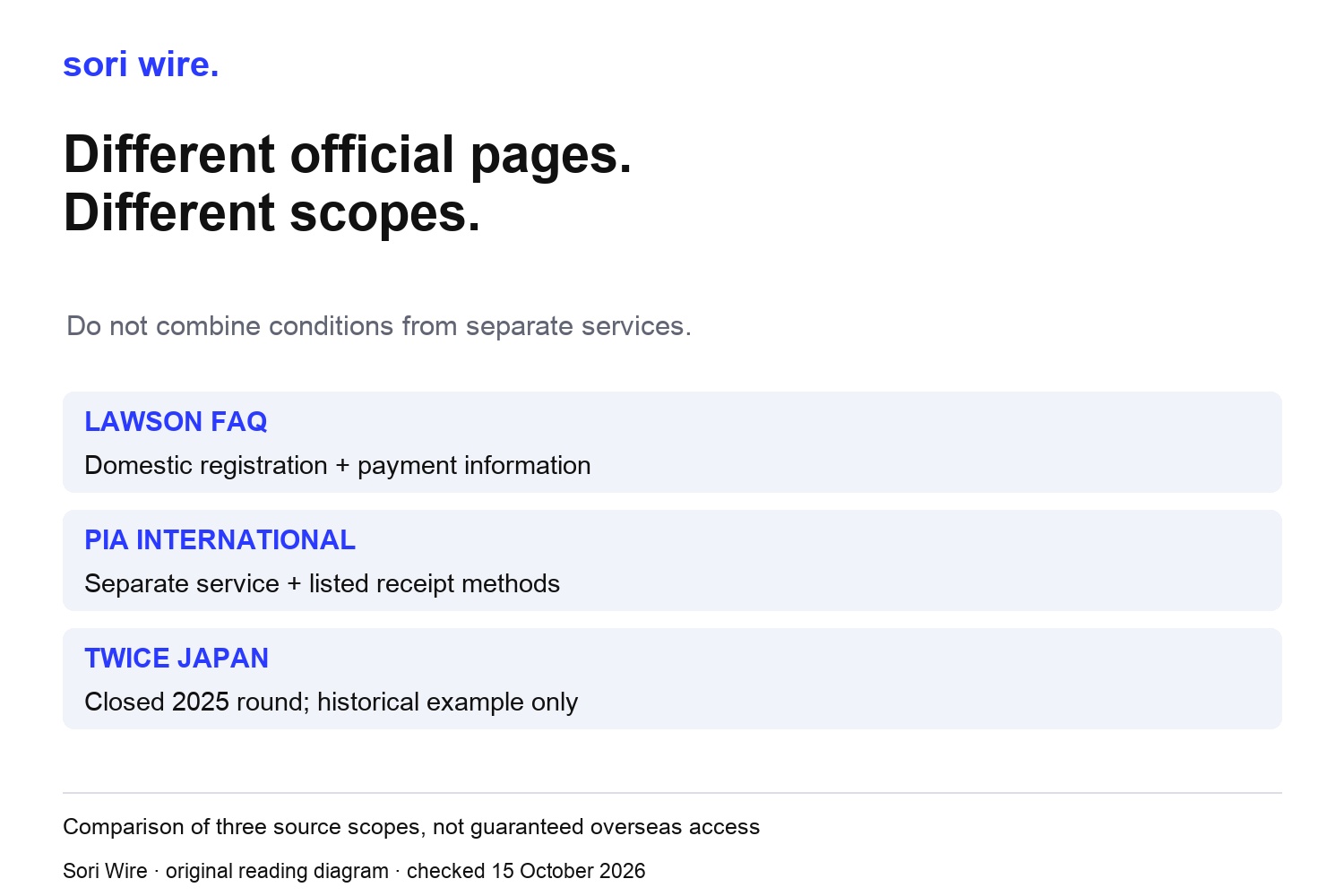
The comparison below is similarly limited. It shows what the three inspected sources describe, and what still needs an event-specific answer. The TWICE round is closed and historical; the provider help pages are general service information checked on October 15, 2026. None of them is presented as a live inventory of tickets available today. Revisit the official destination when you have a current concert in mind and compare its terms with your saved note.
This approach makes translated information easier to use without pretending that translation removes access restrictions. It also gives support a clearer question: which stated route are you using, and which requirement is unresolved? You can enjoy following a Japan tour while keeping your purchase decision separate from the excitement of an announcement. A useful ticket plan explains the actual route, leaves uncertainty visible and never turns an application or a familiar logo into a promise of admission.
Read the chart as a table
| Source | Scope used in this guide | Still check for your event |
|---|---|---|
| Lawson FAQ | Domestic-registration and payment conditions | Actual sale route and eligibility |
| PIA international information | Separate service and listed receipt methods | Which method that sale offers |
| TWICE Japan tour page | Closed 2025 fan-club round example | Current round, year and specific conditions |
How this guide was made
Official service information and TWICE Japan tour page checked October15 2026. Closed2025 round used as historical route-reading example; separate later additional-show information not merged. No checkout, login, payment, ticket receipt or device admission tested. TWICE THIS IS FOR artwork is unchanged official representative album artwork, not tour photography. Three Sori Wire diagrams are editorial reading frameworks, not guaranteed booking flows or sales-platform screenshots.