K-ERA Fest Seattle: Concert Cancelled, Convention Postponed
A source-linked guide to the cancelled TAEMIN concert, the convention’s spring2027 plan, and the ticket questions that still need confirmation.
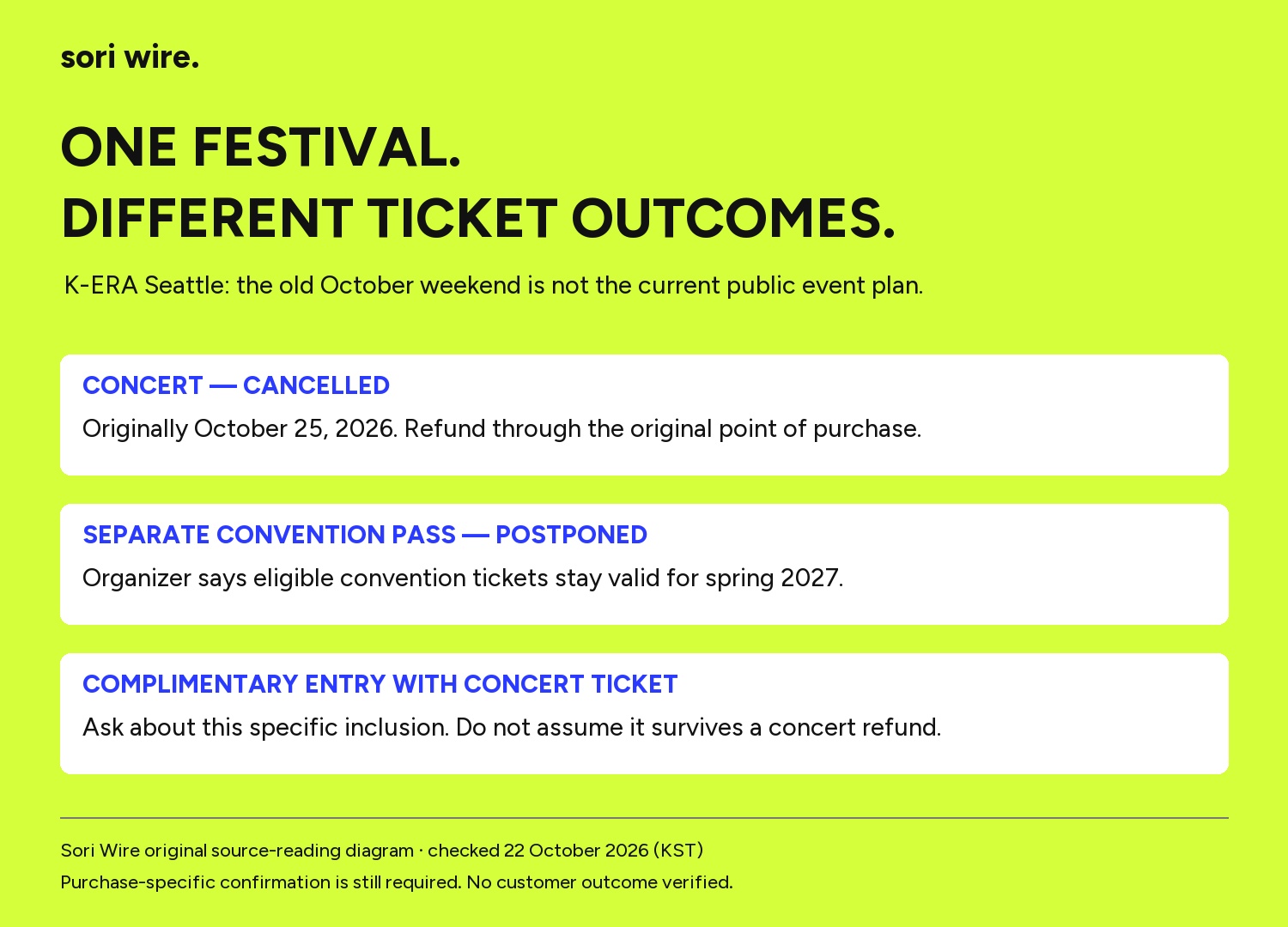
If your K-ERA Seattle plans were built around the October 2026 weekend, start by separating the experiences on your confirmation. The TAEMIN concert at Climate Pledge Arena is cancelled, while the public convention has been postponed to spring 2027. Those changes lead to different announced ticket routes. This guide compares the organizer’s update with the venue’s event notice and explains how to keep unresolved questions visible, especially for convention access originally included with a concert ticket. Status checked October 22, 2026 (KST); this is our verification date, not a claim that the cancellation was first announced today. No customer order, refund outcome or replacement performance has been verified.
At a glance
- Concert
- Cancelled; announced refund route is the original point of purchase.
- Convention
- Postponed to spring2027; separately purchased passes have their own continuation/refund instructions.
- Date target
- November30 is the organizer’s announcement target, not a new event date.
- Included access
- Do not assume complimentary convention access survives a concert refund; obtain order-specific confirmation.
In this guide
Start with the event and the purchase
The planned K-ERA weekend involved a public convention and a separately ticketed concert. The organizer’s current update places those experiences on different paths: the convention moves to spring 2027, while the concert scheduled for October 25 is cancelled. Climate Pledge Arena independently labels its TAEMIN event cancelled and directs concert refunds through the original point of purchase. Keep those statements attached to their named event rather than reducing everything to a single festival-wide refund rule.
For your own records, write the purchase title exactly as it appears on your confirmation. Then add the seller and the original date. This small identity check matters because an artist’s name can appear on more than one event, and a festival can sell more than one kind of access. A Seattle concert order, a separately bought convention pass and an included convention benefit are not automatically the same transaction. This guide concerns this Seattle event; its cancellation notice should not be applied to another TAEMIN performance.
Our comparison below is a reading tool built from the notices, not an inspection of your order. It shows which question to ask next. We have not signed into a customer account, requested a refund or verified money reaching anyone’s bank.
Concert ticket: follow the original seller
The concert page and venue notice state that concert tickets will be refunded through the original point of purchase. The organizer says no action is needed for that concert refund. That is the announced route; it is not evidence that a particular buyer has already received the money. Retain the order confirmation and look for communications from the seller that processed your purchase.
Ticketmaster’s canceled-event help describes refunds to the original payment method once the relevant organizer funds are received, while noting that transferred and resold tickets have different rules. Use that help only when it matches your actual purchase channel. A ticket visible in an app does not, by itself, tell an editor how it was originally bought or which person receives an available refund.
If a promised update has not reached you, keep your question specific: identify the event, order and seller, then ask about the announced refund route for that order. Avoid making a second purchase merely because an old sales link still opens. A surviving page or promotional image can be part of the event record without establishing that the cancelled performance is taking place.
Convention pass: a different continuation choice
The organizer says convention tickets will be honored for the spring 2027 edition. Its update also offers a contact route for convention buyers who prefer a refund. This is different from the concert’s announced cancellation route. Before using either instruction, establish whether you hold a separately purchased convention pass or are relying on admission included with another purchase.
For a separately purchased pass, save the original confirmation and the update about continued validity together. Your practical next step is to track the future announcement and clarify any order-specific issue with the organizer. Do not translate the general statement about honoring tickets into a promise about a particular replacement day, venue, artist lineup or extra benefit that the current notice has not confirmed.
If you prefer the convention refund route, use the organizer’s published contact details and provide the relevant order information privately. We have not tested that support process or established an individual processing deadline. Keeping a dated copy of what you sent and any reply is an organizational suggestion, not a guarantee that every request receives the same answer.
Included convention entry needs its own answer
The original Ticketmaster concert listing described complimentary admission to the two convention days with a concert ticket. That original offer helps explain why a fan might have no separate convention-pass order. It does not establish what happens to the included benefit after a concert refund. The current organizer update discusses convention tickets remaining valid, but does not expressly resolve every concert-ticket bundle scenario.
Leave that field marked “confirmation needed” rather than placing it in the automatic rollover column. A useful private inquiry would identify the concert purchase and ask whether its included convention admission has any continuing validity, whether a separate confirmation is required and which instructions apply to that exact order. These are proposed questions; they are not answers we received from support.
The distinction also keeps the comparison honest for fans who paid for a convention pass separately. Their notice should not be used as proof of an unstated benefit for a different purchase. Two readers may see the same festival name and still need different follow-up questions.
Separate the old dates, the new window and the announcement target
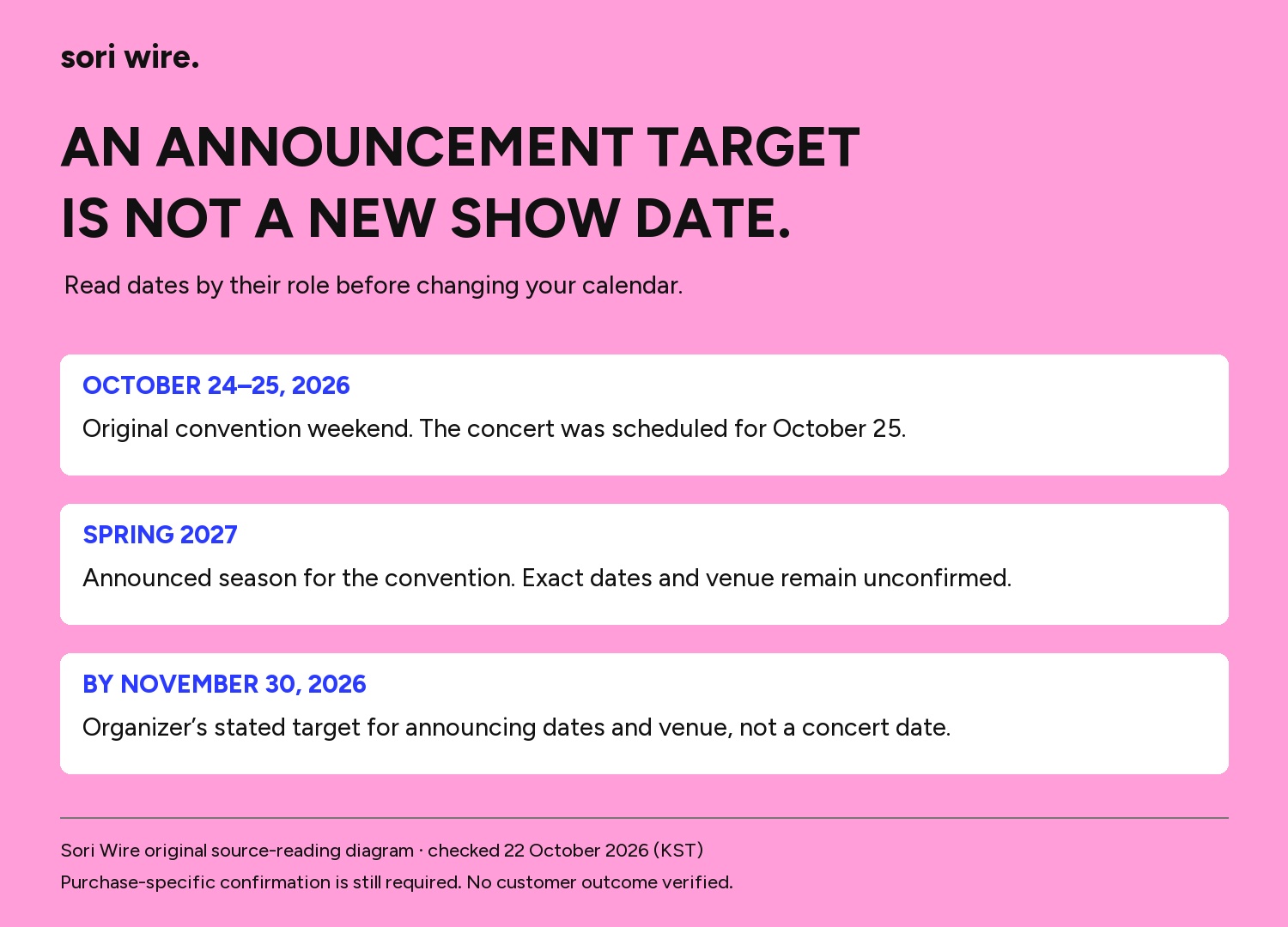
October 24–25, 2026 was the original convention weekend, and October 25 was the original concert date. Those dates remain useful identifiers when finding an order or reading an old poster. They are not replacement dates. The venue’s cancelled-event page still displays original event-calendar information alongside the cancellation statement; read the status before treating a displayed clock as a plan to attend.
The 2027 organizer page gives spring 2027 as the convention window and says exact dates and the venue will be announced by November 30, 2026. Treat November 30 as the organizer’s stated announcement target. It is not a new concert date, a confirmed convention opening day or a buyer’s refund-request deadline. We do not convert that date into a precise hour or invent a timezone that the promise does not specify.
In a calendar, an unresolved item can remain a note linked to the source rather than an invented appointment. That lets you distinguish information you are waiting for from a date the organizer has actually fixed.
Use the detailed update, not a placeholder heading
When we checked the organizer’s separate Refund Policy page, it described itself as a structural placeholder awaiting legal review. Its title is not a substitute for a finished policy. We therefore use the specific event update and the venue’s cancellation message for the announced event facts, and do not present the placeholder as a set of binding consumer terms.
This is a practical way to read event websites more generally: open the destination of a promising link and check what it actually contains. A page called FAQ may still be under construction, and a footer link can exist before detailed content is published. Record the gap instead of filling it with a familiar rule from another event.
Keep the latest event-specific notice with the order to which it applies. If you need clarification, point support to the unresolved sentence or inclusion. A narrower question is easier to connect to the seller’s actual instructions than a broad assumption that every ticket for a brand follows the same process.
Build a short private record you can update
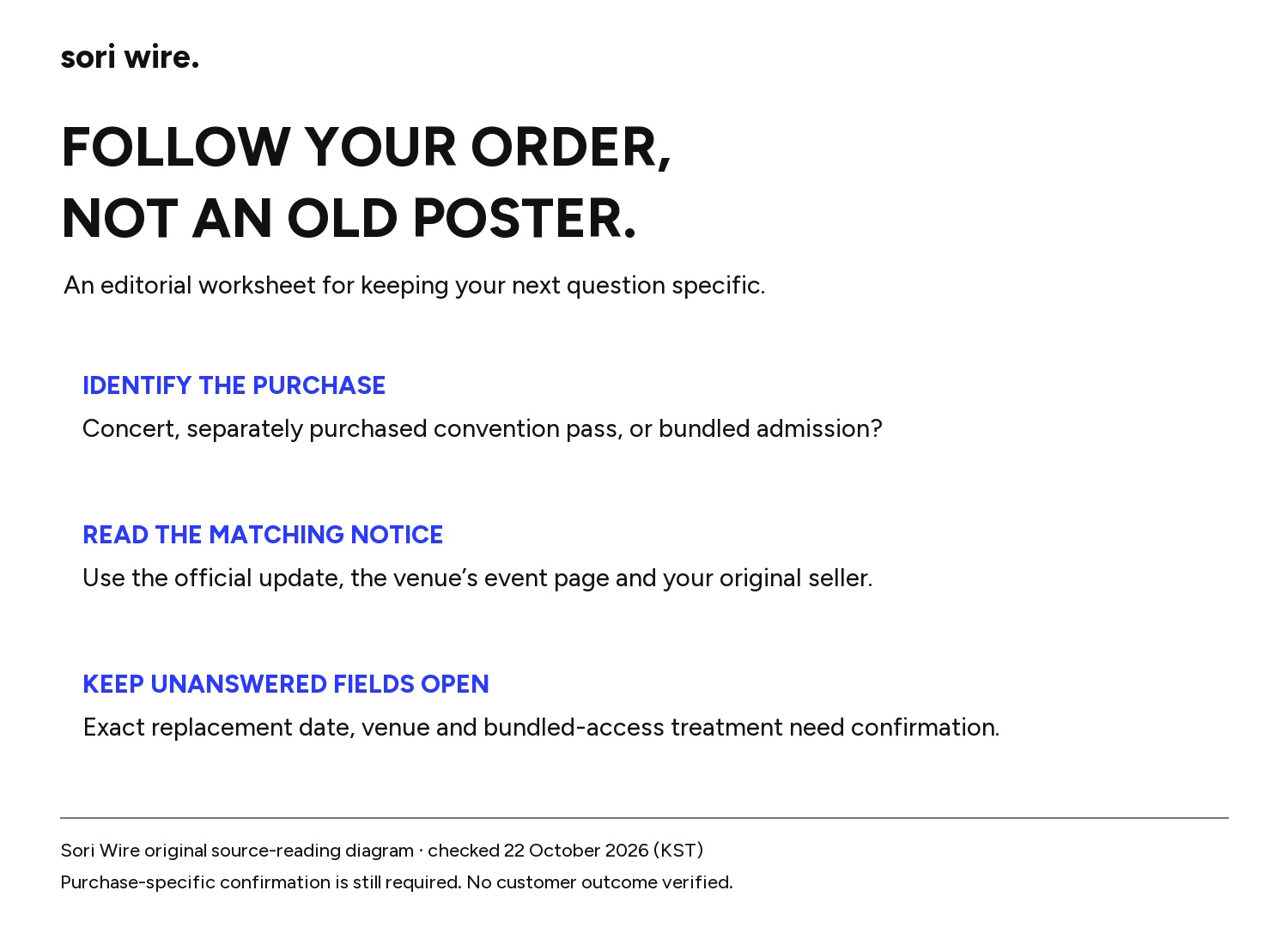
Start with four fields: what you purchased, who sold it, the status attached to that specific experience and the source you checked. Add a separate field for what is still unknown. For this case, possible open questions include the exact convention dates, its venue and how an included convention benefit is treated. They are different from a concert refund already described in an official notice.
Keep order numbers, payment details and ticket barcodes out of public posts. If you share a general question with other fans, remove personal information from screenshots first. Use the appropriate private seller or organizer channel for an order-specific inquiry. These privacy and filing suggestions come from our editorial workflow; we have not collected a reader’s ticket or submitted an inquiry on anyone’s behalf.
When a new announcement appears, compare it with the saved record rather than replacing every field at once. Has the date become exact? Has the venue been named? Does the new instruction actually address your ticket category? Keeping the source next to the change helps you see whether a useful answer has arrived or a broader announcement still leaves your specific question open.
How this guide was made
Official venue promotional artwork is preserved in original bytes and shown as an original cancelled-event asset, not attendance photography. Three new Sori Wire diagrams are editorial classifications and question worksheets, not measured statistics or verified customer outcomes. No exact spring2027 date, new concert, notification delivery, legal remedy, private purchase or support interaction is invented. English only; original sources and capture limitations are retained.