K-pop Album Versions Explained: Random Copies, Sets and Preorder Gifts
A practical way to compare formats, photocards and store benefits—with official ILLIT examples and original purchase diagrams.
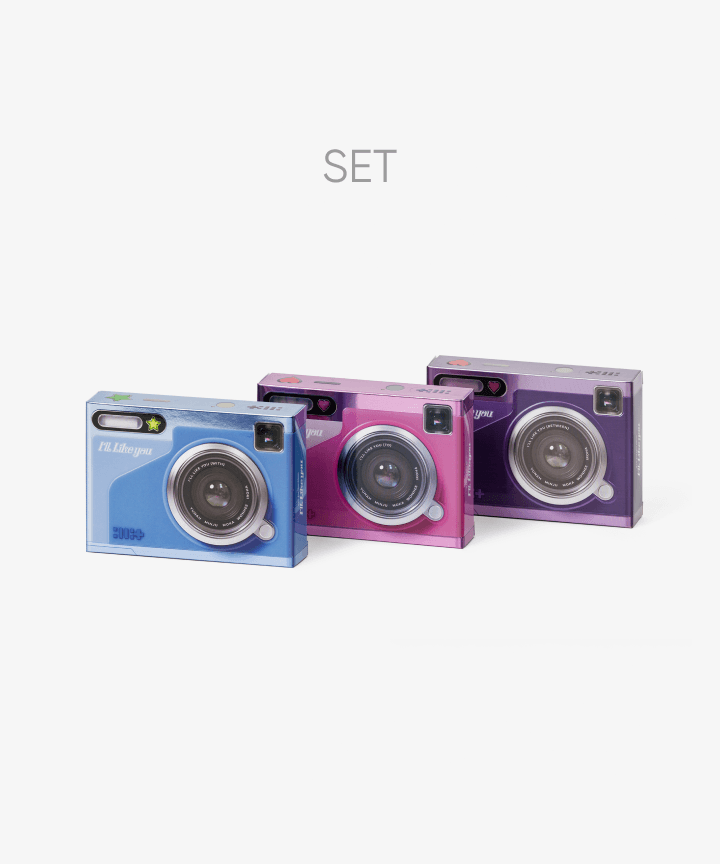
A K-pop album page can look like several purchases hiding inside one purchase: a named edition, a random option, a set, a store-exclusive gift and perhaps a separate lucky-draw event. You do not have to collect every version to make a good choice. The useful question is which exact product meets your goal, and which extras the seller actually promises. This guide gives you a way to read those layers before checking out. We use official ILLIT listings from 2024 and 2025 as archival examples, checked on October 10, 2026. Their preorder benefits and event windows have ended; they are examples of wording, not current buying recommendations. The comparison diagrams and cost worksheet are our own explanatory tools.
At a glance
- Start here
- Separate the package, factory contents and store benefit.
- Random vs set
- A set of versions does not automatically guarantee every random card.
- Examples
- Official 2024–2025 ILLIT listings; past offers, not current deals.
- Your total
- Compare the checkout total for your address, not only the album price.
In this guide
Start with three separate lists
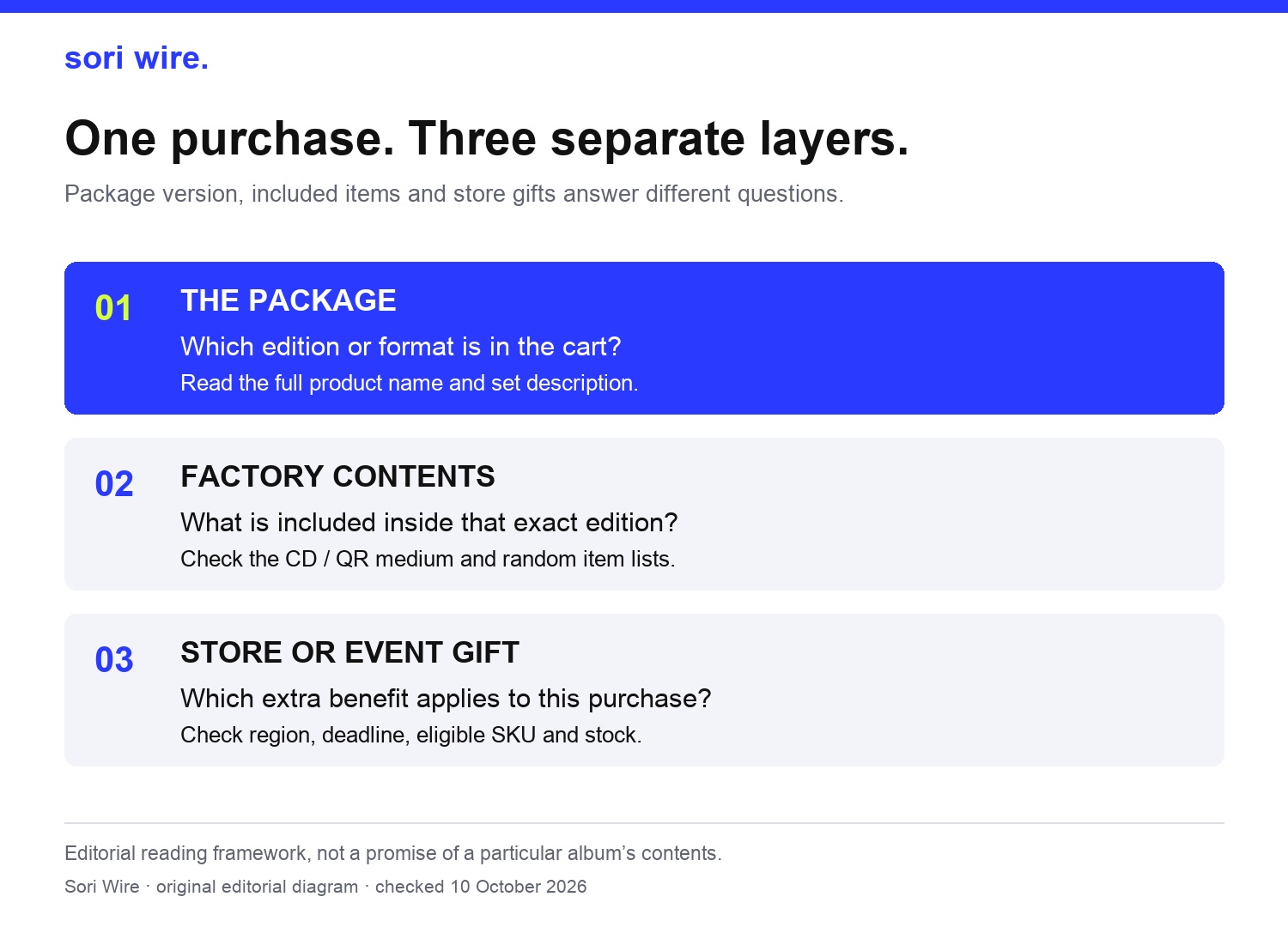
Read an album listing in three passes. First, identify the package: the exact title, format and option that will appear in your cart. Second, inspect the factory contents, meaning the items listed inside that particular product. Third, read the seller’s benefit or event notice. That last layer may depend on where, when and how you buy. A photograph showing several objects is not a substitute for the written description of your selected option.
Our three-layer diagram turns a busy listing into three questions you can answer separately. If a page is unclear about one layer, leave that answer unresolved instead of borrowing a promise from another edition. For example, a store gift shown beside a photobook should not silently become an inclusion inside every album sold elsewhere. Keeping these lists separate also makes comparisons fair: you can decide whether you prefer the actual package before judging an extra card that might be unavailable by the time you order.
Choose the listening format before the cover

The format name deserves as much attention as the artwork. BELIFT LAB issued separate notices for ILLIT’s bomb Weverse Albums version and Merch version in 2025. Those labels distinguish products; neither short announcement alone is a complete inventory of their contents. Open the specifications for the actual item you intend to buy rather than assuming that every product under one album title contains the same disc, photographs or accessories.
Weverse Company’s official app description explains that its platform albums are added through a QR scan and provide music and digital media in the app. By contrast, the archival I’LL LIKE YOU GLLIT listing specifies a mini CD-R. If you want a physical disc, check that the chosen format includes one and that your equipment supports its size. If you prefer app access, read the registration requirements before purchasing. We have not tested offline playback or code transfer, so neither should be treated as a guaranteed benefit of these examples.
Random, selected and set are different choices
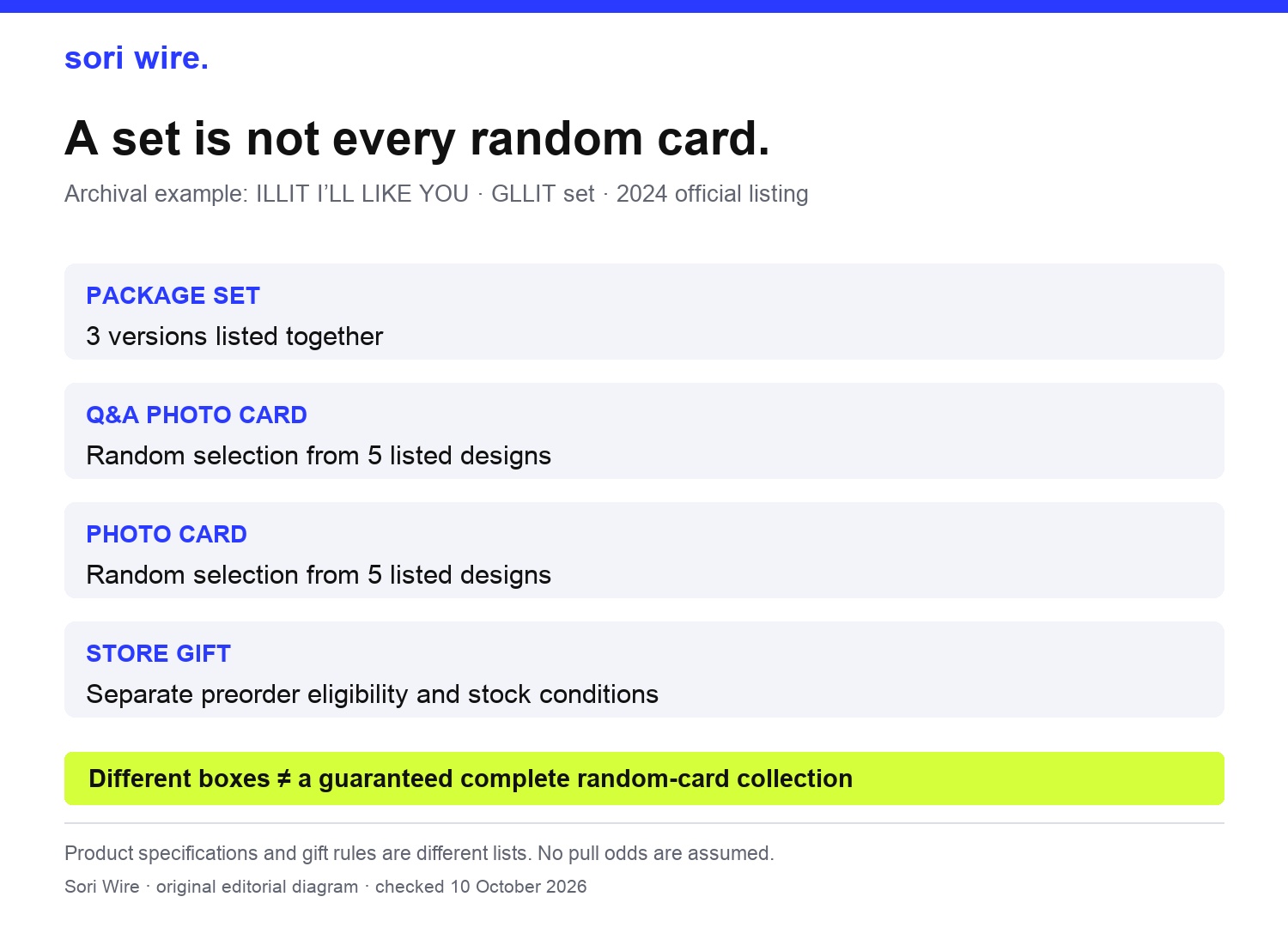
The I’LL LIKE YOU GLLIT set page lists three package versions together, while two photocard categories remain random selections from five possibilities. That is the distinction illustrated here: a complete package set is not automatically a complete collection of every random inclusion. Read the quantity and selection wording for each line rather than letting the word set answer every question on the page.
For any listing, check whether the seller lets you choose a named cover or sends an unspecified version. A member’s name in promotional artwork is not proof that your cart contains a member-selected option. Equally, buying several copies does not establish a guarantee of different pulls unless the seller explicitly promises it. We do not calculate pull odds here because the official pages do not state a packing distribution. The practical approach is to buy the package you would enjoy even if its random card is not your first choice, then treat any collection plan as a separate decision.
Read preorder gifts as conditional extras
The archived Weverse Global bomb notice offered different bonuses for standard and GLLIT purchases. For instance, the GLLIT set benefit included a full five-card B photocard set, while the standard set benefit described random selections. The notice restricted gifts to Global preorder customers and warned that supplies could run out. These are historical offer details, not benefits we are advertising as available today.
When reading a new offer, write down the eligible product, seller, order window, purchase quantity and stock condition in one place. Then compare that note with your cart. Do not assume that a screenshot circulating in a fan chat applies to your shop region or selected format. If the promise is important to you, save the official notice alongside the order confirmation so you can see what was actually stated. This is a record-keeping suggestion, not a guarantee of a refund or replacement; the seller’s current policies and the circumstances of your order still need to be checked.
Global and US labels can change the comparison
The official bomb US notice named MAGIC BOMB, PINK BOMB and STAR BOMB Weverse Exclusive products and listed shipping beginning June 27, 2025. The Global notice used a different shipping schedule. These regional pages concern orders, not two different worldwide music release dates. A search result that shows one region’s notice should not become a promise about an order placed through another storefront.
For a current purchase, begin with the shop that serves your delivery address and inspect that shop’s own specifications. Compare an exclusive item only when its exact inclusion is documented; the word exclusive on its own does not explain what is different. Keep order limits, delivery eligibility and potential charges attached to the same regional listing. If you need to switch regions to see an item, recheck the whole cart rather than carrying conditions over from the first page. We are explaining a comparison method here, not ranking retailers or recommending that fans bypass regional purchase restrictions.
Separate release, dispatch and arrival
The two BELIFT LAB bomb format announcements shared a June 16, 2025 release date, even though their preorder opening dates differed. The US store’s shipping notice was later. This illustrates why an order page can contain several dates without contradicting the music announcement. Album release, a format’s preorder opening, warehouse dispatch and delivery to your door are different milestones.
For your own order, keep a small record of the promised dispatch window and the delivery estimate shown for your address. Do not replace an estimate with an exact arrival date just because you know when the songs come out. A retailer may describe shipping as beginning on a date, which is different from saying every order leaves that day. If your order status changes, use the seller’s order information and customer-support channel for that purchase. Listening to the release and waiting for a parcel can be planned separately; you do not need to treat an unshipped album as proof that an artist’s release was delayed.
A lucky draw is its own event
Weverse’s July 2025 second bomb Lucky Store event accepted the standard and GLLIT albums, excluded other formats, and gave different numbers of draws for their sets. Its gifts were randomly selected and available while supplies lasted. This was an on-site promotion with its own rules, rather than a continuation of every earlier preorder bonus. The event has ended, so those rules are included only as an archival example.
Apply the same reading method to a current lucky draw or special sales event: locate the actual event notice, check the qualifying product and find the participation instructions. Buying the artist’s album in an unrelated shop should not be treated as entry. Nor does a random gift mean a chosen member is guaranteed. If a post mentions a fan event but does not explain selection, eligibility or the sales channel, follow the official notice before making plans. This guide does not establish that any present event is running, or that purchasing an album grants access to an artist.
Compare the whole cart, not the album price
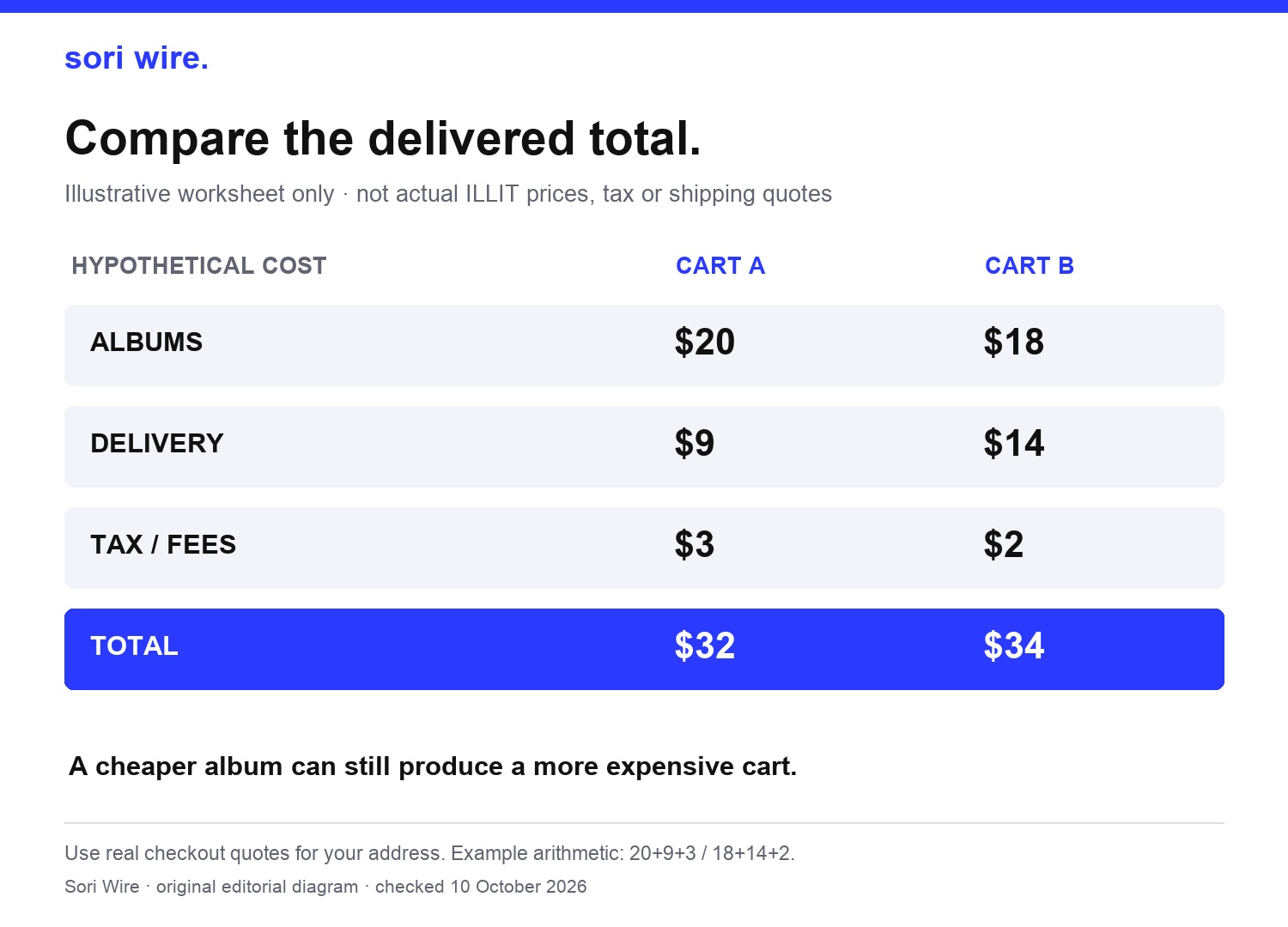
Our cost worksheet uses invented example amounts clearly labelled as illustrative, not current retailer quotes. Cart A contains a twenty-dollar album, nine-dollar delivery charge and three dollars of taxes or fees: thirty-two dollars in total. Cart B has an eighteen-dollar album, fourteen-dollar delivery charge and two dollars of taxes or fees: thirty-four dollars. The simple arithmetic shows why a lower sticker price does not necessarily produce a lower delivered total.
For a real comparison, replace every example amount with a checkout quote for the same address and currency, then note any costs that remain unknown. Do not silently treat an unknown charge as zero. Compare the quantity of albums as well as the extras; a large set and one random copy are different purchases even if one includes more gifts. Decide your comfortable total before looking for another bonus. You can support an artist without turning a small purchase into an expanding collection, and this guide is not a reason to spend beyond that limit.
Read the chart as a table
| Illustrative USD cost | Cart A | Cart B |
|---|---|---|
| Album | 20 | 18 |
| Delivery | 9 | 14 |
| Tax / fees | 3 | 2 |
| Calculated total | 32 | 34 |
Ask what the QR code actually unlocks
Not all album QR codes do the same job. The Weverse Albums app description explains music registration through scanning, while the archived GLLIT product page separately mentions a purchase-verification and survey QR included in the first production round. A survey code should not be described as a substitute for a music disc simply because both involve scanning a square code.
Look for the code’s purpose in the product guide before using it. If you cannot tell whether it registers music, verifies a purchase or opens another service, keep that question open and ask the seller through its official support channel. Avoid sharing a full registration code in a public haul photograph. For a secondhand purchase, ask whether any code has already been used and consult the platform’s current rules; this guide does not promise that a code is transferable, resettable or reusable. A clear answer about access is more useful than an attractive picture of packaging that leaves the listening format uncertain.
Make a purchase note you can actually use
Before checkout, make a short note with the album title, selected edition, number of copies, music format, random inclusions, eligible bonus, delivered total and expected dispatch window. Add the exact shop link and the date you checked it. This is our suggested worksheet, not information a retailer has necessarily verified for you. Its value is that an unanswered question stays visible instead of becoming a guess.
You can use the note to choose among three goals: owning one version you like, receiving a specific documented package, or pursuing a particular conditional store benefit. These goals can overlap, but none requires buying everything. If a benefit has ended or the product is sold out, retain the comparison as a reference rather than hunting for an unofficial promise that sounds better. For new releases, return to fresh official product pages: the old ILLIT examples teach you how to read a listing, while current listings must supply the actual terms of your next purchase.
How this guide was made
Official product and artist sources were checked on October 10, 2026. The 2024–2025 sales and event examples are archival; stock, benefits and terms must be rechecked for any new purchase. Artist and product images are attributed to their original official sources; attribution does not establish a reuse license. Sori Wire created the three explanatory diagrams. The cost worksheet uses hypothetical figures with explicitly calculated totals, not market prices, and we have not purchased or unboxed the products for this guide.