K-pop Fansign Raffles Explained: Entry, Winners and Video Calls
Read the right event notice, distinguish a purchase from an application, and prepare for the format you actually entered—with official TWS examples.
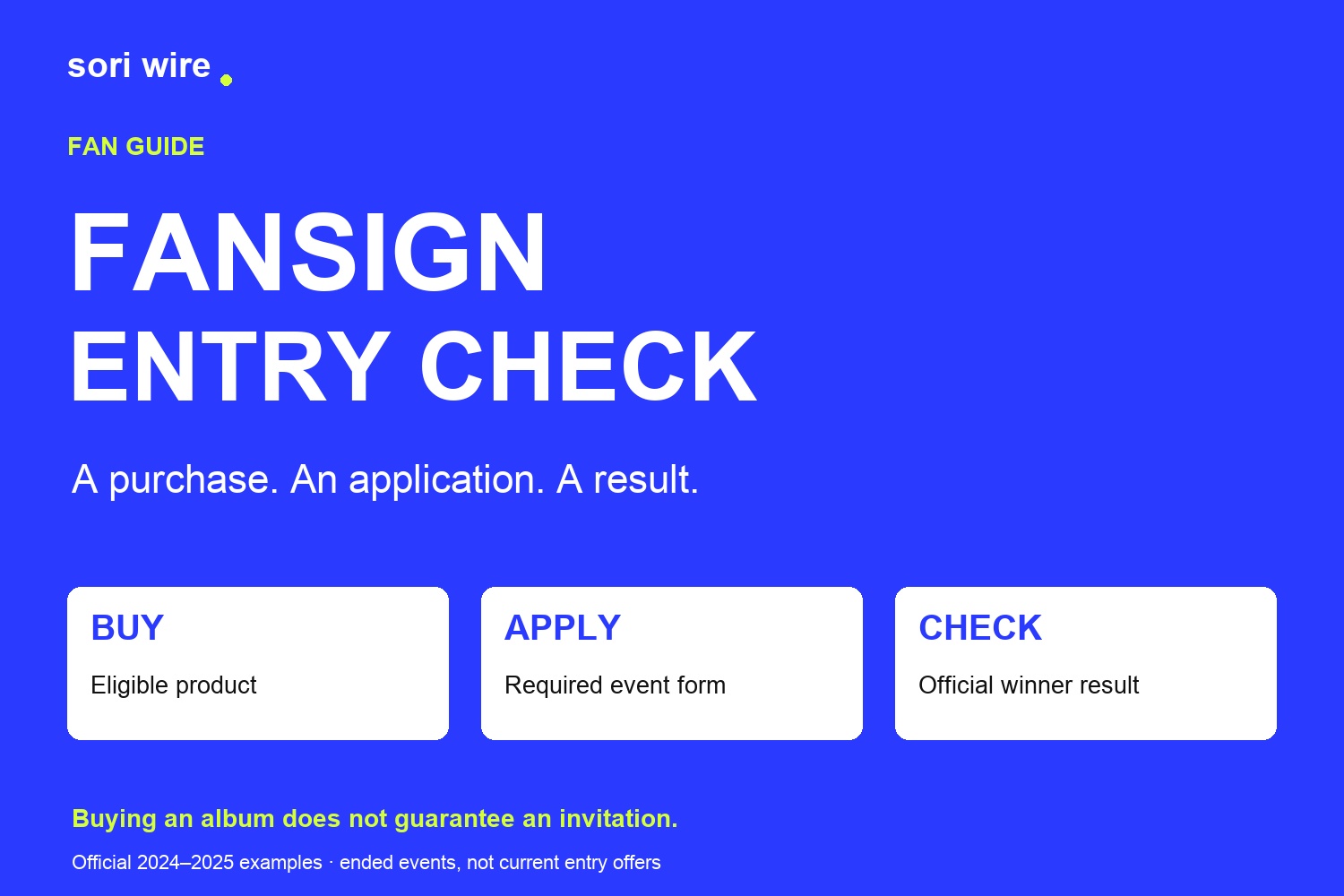
An album in your cart, an event application and an invitation are three different things. That distinction matters when you are reading a K-pop fansign announcement from another country, especially if the notice combines shopping details, a raffle, identity checks and a video call. This guide gives you a practical way to read the announcement before deciding whether to apply. We compare official TWS notices from 2024 and 2025 as historical examples, checked on October 10, 2026. Those events have ended. Their dates and conditions are not current offers, and we are not inviting readers to enter them. The diagrams are our own source-linked explanations, designed to help you inspect a new notice without assuming its rules match an old one.
At a glance
- Three stages
- An eligible purchase, event application and winner result are separate records.
- Call format
- A selected-member call can differ from a group call. Read the exact notice.
- Odds
- An announced winner count does not establish your personal chance.
- Examples
- All cited 2024–2025 events have ended; this is a reading guide, not an open invitation.
In this guide
Start with the event, not the album title

An album campaign can include a showcase, an in-person fansign and a video-call event. They may share an artist and an album title while offering different experiences. PLEDIS published a separate TRY WITH US showcase notice, and the earlier Sparkling Blue video-call notice explicitly excluded a showcase-labelled product from fansign eligibility. The shared album name was not enough to connect those purchases to the same event.
For a new announcement, make a short event heading of your own: artist, album, organizer, event type and date. Then keep the eligible product link beside that heading. This is an editorial reading method, not a replacement for the organizer’s application instructions. It helps you spot a mismatched screenshot or an old announcement before treating it as relevant to your plans. If the event type or sales channel remains unclear, follow the linked official notice rather than filling the gap from a fan’s recollection of another promotion.
A purchase can qualify you without submitting the form
The archived Sparkling Blue and Last Bell Weverse notices required both an eligible purchase and a separate manual raffle entry, using the account that made the purchase. An order confirmation therefore answered a shopping question; it was not automatically proof that the event form had been submitted. This is one of the most useful distinctions to look for in a new announcement.
Before applying, identify the exact product linked from that event, the required account and the place where the organizer says to enter. After following the official instructions, keep the order record and the event-entry status as two separate records. If you can see a paid order but cannot establish whether you entered, use the event’s official support route while its application window remains open. Do not assume that a delivery status will resolve an application problem, or that a message from an unrelated seller confirms your entry. The organizer’s current process must supply the answer.
A group call and a selected-member call are different
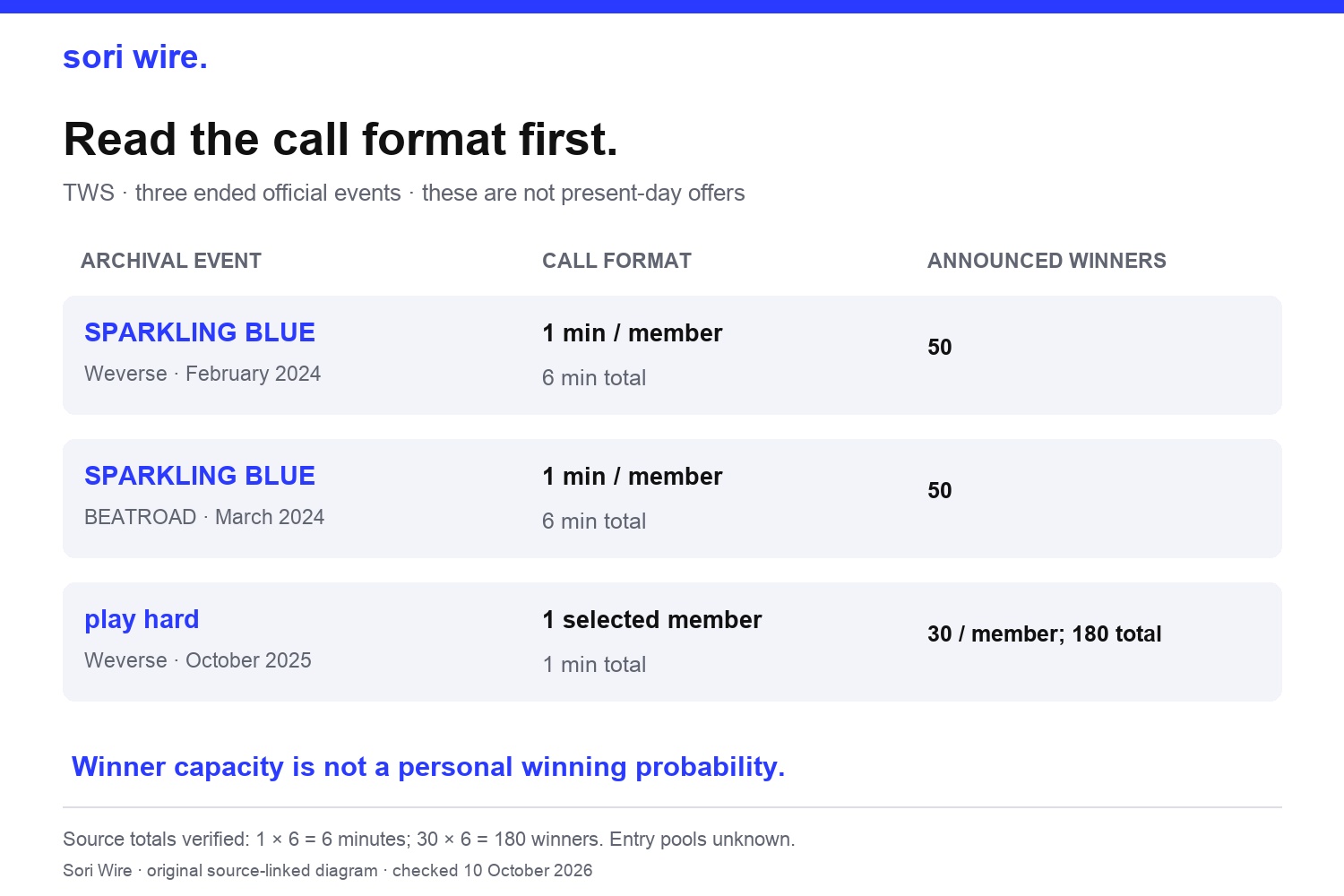
Two official Sparkling Blue examples described one minute per member and six minutes in total. The later play hard notice described a one-to-one event with one selected member for one minute. Its eligible purchase and entry link were member-specific. These historical notices show why the phrase video call does not tell you who will be on the call or how long the whole experience will last.
Our comparison table keeps those formats separate. For a new event, check whether you are choosing a particular member, entering a group format or applying to another structure. Do not promise yourself a conversation with every member because that happened in an earlier event. Similarly, a stated duration is not a reason to plan extra time after the call is scheduled to end. Once you have the actual format, prepare a brief greeting or question that fits it and follow the winner instructions for the event you entered.
Read the chart as a table
| Archival TWS event | Listed call format | Announced winners |
|---|---|---|
| Sparkling Blue / Weverse, February 2024 | 1 minute per member; 6 minutes total | 50 total |
| Sparkling Blue / BEATROAD, March 2024 | 1 minute per member; 6 minutes total | 50 total |
| play hard / Weverse, October 2025 | 1 selected member; 1 minute | 30 per member; 180 total |
Keep the closing date, result and event date apart
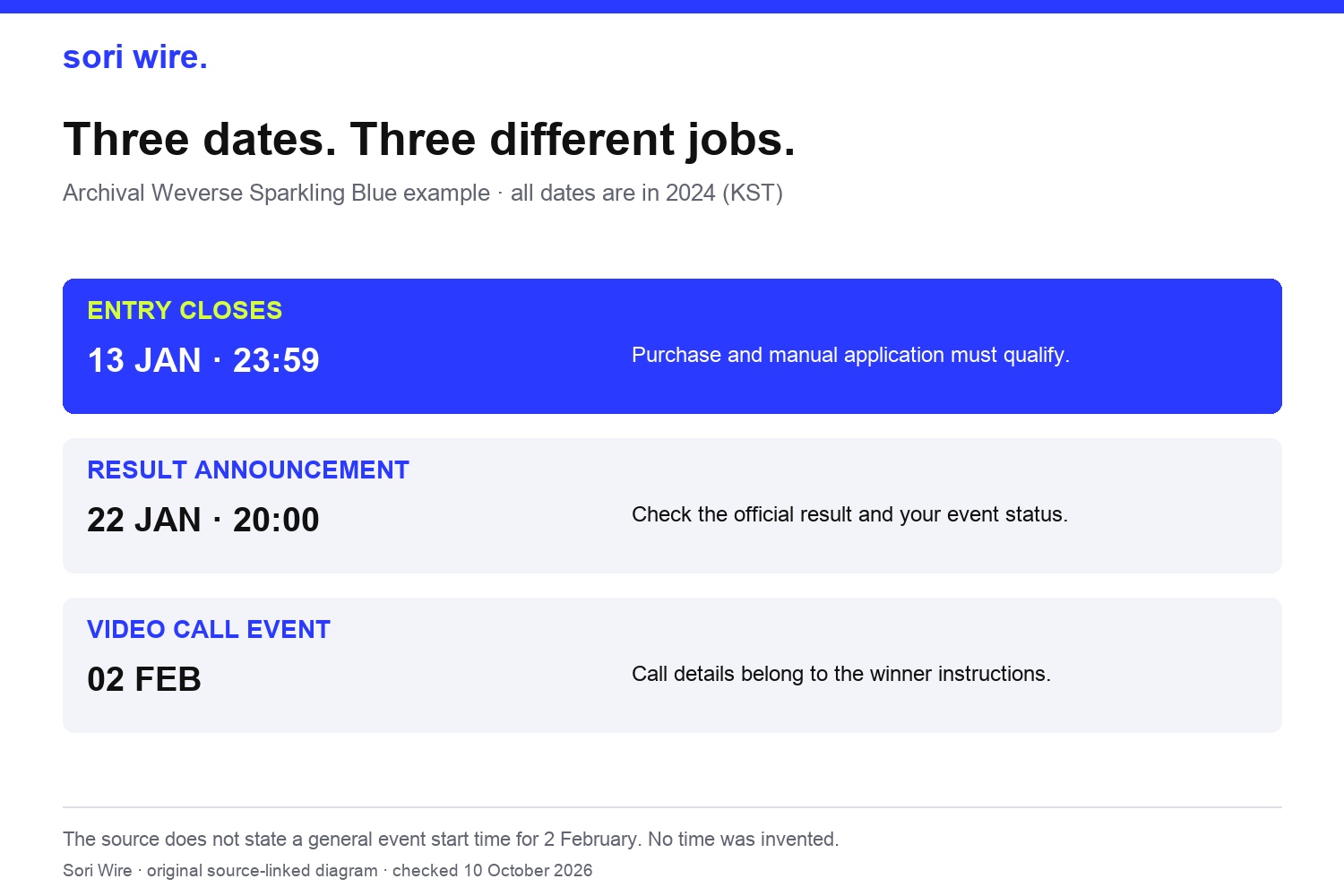
The archival Sparkling Blue Weverse example closed applications on January 13, 2024, listed a winner announcement for January 22 and placed the video-call event on February 2. The timeline reproduces those separate jobs. It does not invent a general starting hour for February 2, because the source did not provide one. In the BEATROAD example, the announcement wording allowed results at the stated time or later, another detail that matters when waiting for a result.
For a new event, label each date before putting it in your calendar. An application deadline is something you need to meet; a result announcement is something to check; an event date becomes an attendance plan only if you are selected and receive the necessary instructions. A calendar reminder by itself does not prove any of those steps happened. Keep the original timezone and the official link with the date, and recheck the notice for changes rather than interpreting silence as confirmation that everything is proceeding exactly as first announced.
Read the chart as a table
| Archival 2024 milestone | Official date / time (KST) | Meaning |
|---|---|---|
| Application closes | January 13, 23:59 | Qualifying purchase and manual entry |
| Winner announcement | January 22, 20:00 | Check official results |
| Video-call event | February 2; general starting hour unspecified | Follow winner-specific instructions |
A winner count cannot tell you your chances
The play hard announcement listed thirty winners per member and one hundred eighty in total; Last Bell’s offline notice listed fifty winners. These are announced event capacities. Neither number, on its own, establishes a personal probability of selection. We have not calculated one because the supplied notices do not reveal the necessary entry pool or a complete selection model.
Treat a capacity number as context for the event, not as a spending target. A claim that a particular purchase quantity guarantees selection needs evidence the notice has actually supplied; an anecdote from a previous winner does not provide that evidence. Our practical recommendation is to decide whether the album purchase makes sense to you even without an invitation. More spending should not become a substitute for checking eligibility or completing a required form. This guide offers no winning strategy, and it does not recommend buying a quantity based on guessed odds or a supposed minimum reported in a fan chat.
Check your application details before submitting
The official notices place identity verification between selection and participation. The archived special offline notice specified accepted identity documents and rejected ordinary copies or screenshots, with separate provisions for specified mobile IDs. The play hard notice required application details to match the participant and did not allow the winner’s right to be transferred. These are rules of the cited events, not a universal list of documents accepted at every fansign.
Before entering a new event, inspect its own name, age, identification and contact requirements. Compare them with the information you can actually provide, and ask the organizer about an unclear requirement before submitting a form that may not be editable. We do not ask readers to upload identity documents to Sori Wire, and there is no need to post them in a public fan group to get informal help. Keep any required verification within the organizer’s legitimate process. Never assume that a stage-name nickname, a screenshot or another person’s document will satisfy a requirement the notice describes differently.
A participant benefit is not an invitation
The archived Last Bell notice separated benefits for raffle participants from benefits for winners, and said winners would be invited to the in-person fansign. A participant’s extra item therefore did not establish that the person had been selected to attend. Shopping benefits, entry status and winner status need their own evidence, even when they appear together in one long announcement.
For a new event, read the result through the channel named by its official notice and match it to your own application. A parcel, a promotional message or an event-themed photocard is not a substitute for the result. If the organizer sends follow-up instructions to selected participants, keep them with the announcement and your entry record. You can then check what preparation is actually required without copying another fan’s instructions for a different date or format. When a result is unclear, an unanswered question should remain an unanswered question until the official channel resolves it; it should not turn into a public claim that you have won.
Prepare the connection after checking the actual instructions
The BEATROAD Sparkling Blue notice specified KakaoTalk for its video call and described a limited, conditional retry procedure when a connection failed. That procedure was part of that historical event. It should not be treated as a promise that another organizer will keep calling, extend a conversation or compensate for a missed connection.
For an event you have genuinely been selected for, use the winner instructions to check the app, contact details and required availability. Our suggested preparation is simple: confirm that you can access the account you supplied, charge your device, choose a quiet place and keep the verification material the organizer requires ready. These are practical suggestions, not a claim that we have personally attended or tested this fansign. Read any conduct and recording rules as well. A short call works better when your greeting is ready and you follow the stated ending, rather than relying on extra attempts or an exception you hope staff will make.
Read cancellation conditions before a purchase becomes an entry
The play hard event notice attached specific cancellation and refund conditions to its event-exclusive products. It also explained that canceling all qualifying orders would cancel participation. The important reading lesson is that an event purchase can carry conditions tied to the application and winner-announcement stages, rather than behaving like every other item in a shopping cart.
For a current event, locate those conditions before deciding to buy and retain the official text with your order. If you need to cancel or dispute a purchase, ask the seller through its official process; this guide does not decide your legal rights or promise a refund outcome. Do not assume that failing to win automatically reverses the purchase. Equally, do not copy an old event’s restriction into a new order whose seller or conditions are different. Understanding the actual commitment is part of deciding whether to participate, and you can choose to enjoy the artist’s music without entering a sales-linked event.
Build one small record for the exact event
Our suggested event record contains the official announcement link, organizer, event format, eligible product, application deadline, result channel, event date and any unresolved questions. Add your order reference and entry confirmation privately after completing the relevant steps. Keep public announcement information separate from personal verification material and winner-only location details. A fansign checklist should help you manage your own participation, not expose another fan’s documents or a private venue instruction.
Use that record to ask a precise question when something is missing: which product qualifies, where the application is submitted, whether a document is accepted or how the organizer will contact you. A precise question is more useful than asking a fan group to guess if you are all set. When checking a new event, return to its fresh official notice rather than revisiting the expired examples in this guide as if they were open offers. The goal is a clear decision based on the real invitation process, with no invented odds and no assumption that buying an album has already secured a place.
How this guide was made
Official notices and the TWS Japan profile were checked on October 10, 2026. Dates, formats and capacities are archival reported terms, not present-day event offers. Sori Wire created the application diagram, event comparison and timeline; the arithmetic checks only the reported totals, not winning probabilities. The official group photograph is representative, not fansign photography; attribution does not establish a reuse license. We have not personally attended or tested these events and do not collect reader identity documents.