K-pop Labels Explained: Company Names, Artist Rosters and Group vs. Solo Pages
Read layered company names without mixing up label profiles, wider business lists, group activity, solo pages and editorial news categories—with official ILLIT and ROSÉ examples.
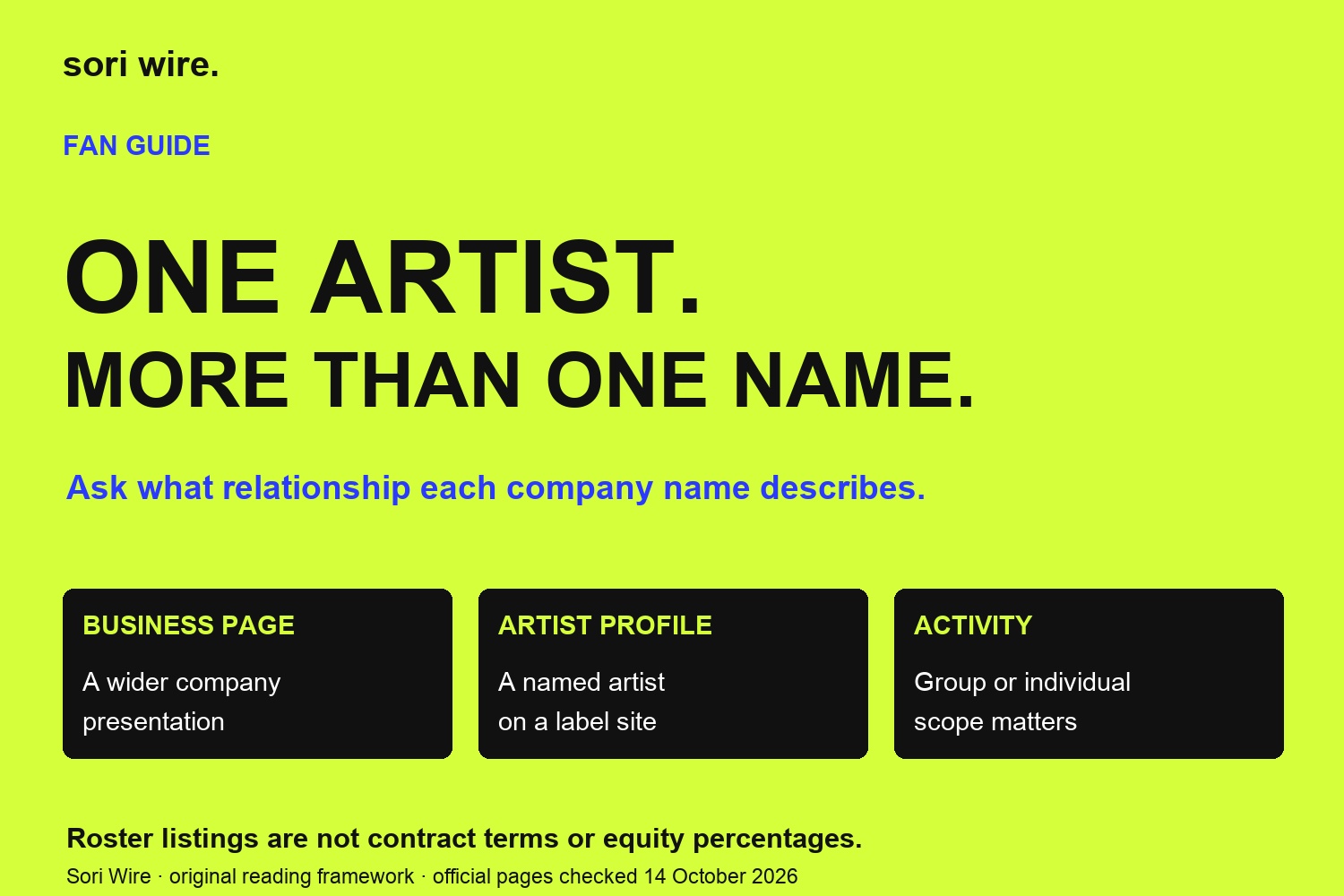
You search for a group’s company and find several names: a familiar music company, a more specific label and a platform carrying the announcement. Then a member releases solo music on another official artist page. These results do not necessarily contradict one another; they may describe different relationships. This guide shows how to read company and artist pages without flattening every name into one universal agency tag. It uses dated official HYBE, BELIFT LAB, YG and THEBLACKLABEL observations, plus original diagrams. It is a practical source-reading guide, not a complete ownership chart or an audit of artists’ private contracts.
At a glance
- Layered names
- HYBE lists BELIFT LAB among its music businesses; BELIFT LAB publishes ILLIT’s profile.
- Activity scope
- YG’s BLACKPINK page and THEBLACKLABEL’s ROSÉ individual page coexist.
- Evidence limits
- A roster or business listing does not reveal private contract terms or equity percentages.
- News categories
- An editorial roundup grouping is not itself a corporate ownership statement.
In this guide
Ask which relationship the company name describes
Before choosing one company name, decide what question you are trying to answer. Are you looking for the label presenting the artist, a broader business group, the publisher of a particular notice or the destination for a fan service? A single search result may not answer all of those questions. A good note keeps the relationship next to the name instead of storing a company label that silently changes meaning whenever you reuse it.
HYBE’s current business page describes a multi-label system and displays named music businesses, including BELIFT LAB. It separates its platform section from that music presentation. BELIFT LAB’s own introduction identifies the label and describes its work in music content and artist-related business. These public descriptions provide a useful starting point, but they do not turn every business listed on a company page into one interchangeable artist-management team.
Our suggested reader labels are business presentation, artist profile, announcement publisher and service platform. They are Sori Wire’s note-taking categories, not the companies’ official legal classifications. Use them to keep your evidence specific. If you need an exact ownership percentage or the terms of a contract, a general artist profile is not a source for that answer. This guide does not supply those missing details or infer them from shared branding.
Follow the HYBE → BELIFT LAB → ILLIT page trail
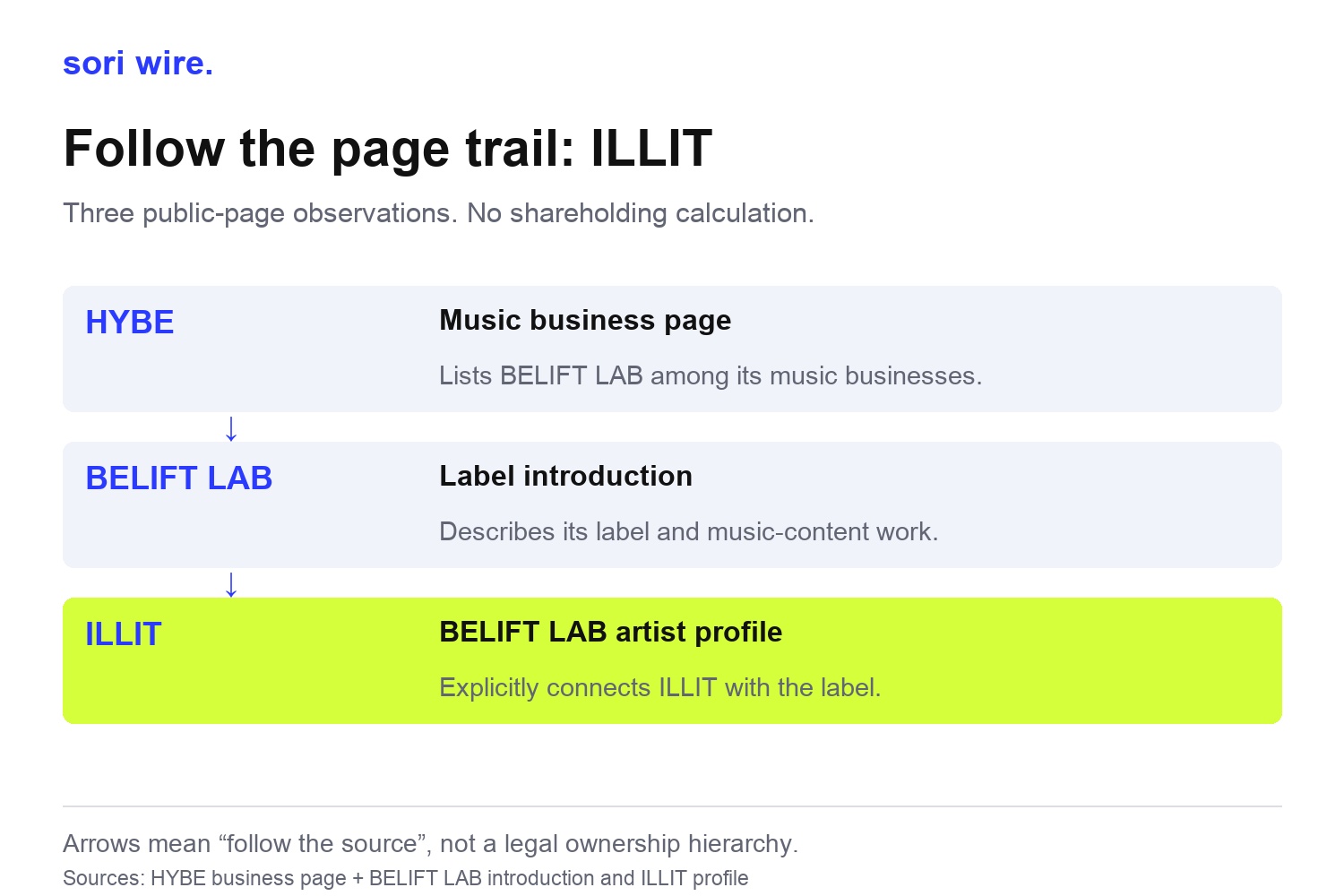
The official pages give a concrete example of layered names. HYBE lists BELIFT LAB in the music section of its business page. BELIFT LAB then provides an ILLIT artist profile that explicitly connects the group with the label. A reader can preserve both observations rather than treating HYBE and BELIFT LAB as rival answers to a question that was never defined clearly enough.
The diagram below illustrates the page trail we checked. Its arrows mean follow the linked source; they do not represent a calculation of share ownership. The label’s artist page is where this example establishes the ILLIT association. The wider business page establishes how HYBE presents BELIFT LAB within its music businesses. Keep those two source types separate when you explain the connection to someone else.
This is also a useful way to choose a more precise search term. If you want ILLIT’s own profile or schedule, begin with the label’s artist page rather than assuming a broad company homepage contains every detail. If you want to understand the business presentation, use the broader company source. Neither step requires you to claim that all the artists shown across several label sites have the same contracts, the same staff or a common schedule.
Read the chart as a table
| Official source | Observation used here | What it does not establish |
|---|---|---|
| HYBE business page | Lists BELIFT LAB in its music section | Equity percentage or artist contract terms |
| BELIFT LAB introduction | Describes its label and music-content work | A complete corporate ownership chart |
| BELIFT LAB ILLIT profile | Explicitly associates ILLIT with BELIFT LAB | Another artist’s label or individual contract |
Group and individual profiles can coexist

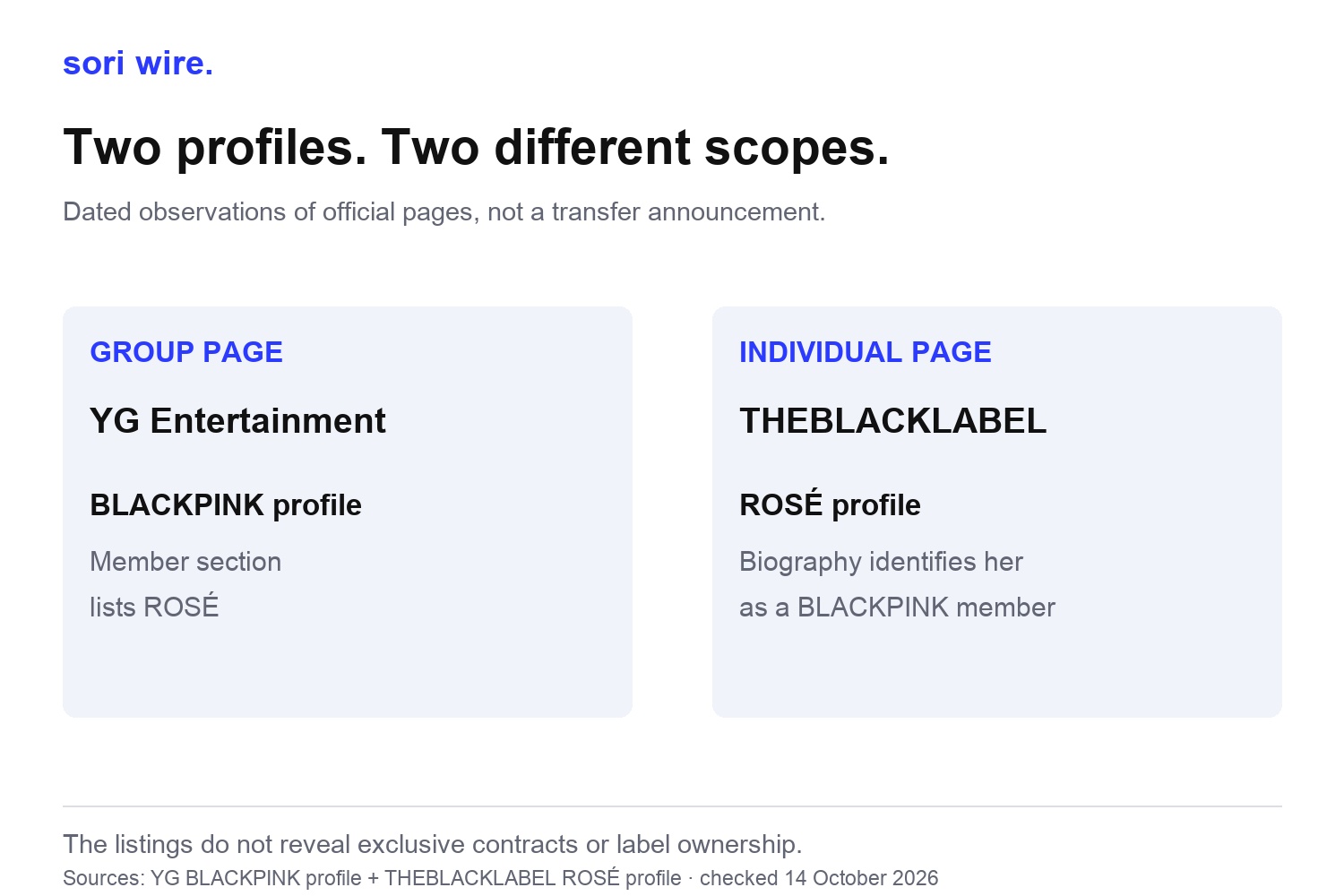
ROSÉ provides a second kind of example. YG’s official BLACKPINK group profile lists her in the member section. THEBLACKLABEL also has an official individual ROSÉ page whose biography identifies her as a BLACKPINK member and discusses solo activity. We checked both pages on October 14, 2026. Their coexistence supports a distinction between group and individual presentation, rather than a headline that one page cancels the other.
The photograph in this section comes unchanged from THEBLACKLABEL’s individual profile, where the image and heading are explicitly labelled ROSÉ. It is a representative official portrait, not a photograph of a signing, a management change or an event we attended. The portrait helps identify the example; the two source pages establish the limited observations discussed here. It does not reveal the contents of any contract.
When saving information about a member, keep an activity field beside the group field. A personal music release, a group performance and a brand appearance should not automatically inherit the same company tag merely because they concern the same person. Read the actual activity announcement for its named parties. This article does not investigate every ROSÉ arrangement or promise that the same distinction applies identically to every member of every group.
A second roster listing is a clue to inspect, not a transfer announcement
Artist menus are useful navigation, but they are not a substitute for a clearly scoped announcement. THEBLACKLABEL’s visible musician menu includes ROSÉ, MEOVV and ALLDAY PROJECT. That tells a reader where those named artist pages can be found on the site. It does not, by itself, establish the ownership of THEBLACKLABEL or make a statement about another company’s role in an artist’s different activities.
Our side-by-side worksheet keeps the BLACKPINK group page and ROSÉ individual page attached to their respective publishers. There is no departure arrow between them. That design choice matters: a familiar organisational chart can suggest a sequence of events that the evidence never reported. If all you have is a pair of current profiles, describe them as a pair of profiles. Save a transfer or renewal claim for a source that actually announces it.
The same restraint is helpful with an artist missing from one menu. Absence from the inspected screen can have several unresolved explanations; it is not a complete contract history. Look for a relevant official statement before making a broader claim. You can still keep the page observation in your source notebook, with its checked date and scope, without promoting it into news about a departure, a suspension or a change in group membership.
The platform hosting a notice is not automatically the artist’s label
A platform and an artist’s label can appear beside the same announcement because they perform different roles in the reading experience. HYBE’s business page presents WEVERSE COMPANY in a separate platform section. BELIFT LAB’s ILLIT profile links to Weverse alongside other destinations. These observations help a reader distinguish the place a message is available from the particular artist or label whose information it represents.
For an individual notice, read the publisher line and the body rather than assigning the platform’s company name to the artist. A host can provide the page while the message names a label, an artist community or an event organiser. Our recommendation is to record both fields when they matter: where you found the message and who the message identifies as its issuer. Those fields may be different without either one being incorrect.
This is especially useful when a screenshot crops away the surrounding page. A logo in the interface can be mistaken for the author of the content. Return to the original notice to recover the context before attaching a company tag. This guide is about that distinction; it does not certify every community on a platform, describe a platform’s full business arrangements or treat a service link as proof of a private contract.
A news roundup category is an editorial choice, not an ownership claim
A publication may organise news by a familiar company name to help readers browse related material. That structure should still explain whether it is using an official label relationship, a broader business presentation or an editorial grouping. Those are different bases for a section. Putting two artists next to one another in a roundup does not establish that their labels have the same owner, and a category title should not do that evidential work silently.
Our recommendation for readers is to treat the section name as navigation, then read the artist and source attached to the specific update. For editors, we recommend keeping the grouping rule visible and retaining the more precise label information underneath it. A useful title can be broad without making the article’s individual claims broad. The article should make clear when a related-label heading is a coverage choice rather than a verified corporate statement.
THEBLACKLABEL’s artist menu, for instance, is a source for that menu’s own named entries. It is not an answer to a separate question about another company’s ownership. If a news site places a THEBLACKLABEL artist in a wider roundup, that placement alone should not become your source for a parent-company claim. Keep the article’s coverage decision separate from the official pages you would need to support the actual relationship.
Keep the checked date and scope when names change
Company sites, artist pages and contact destinations can change. A note that simply says current agency can become ambiguous as soon as you return to it for a different activity. Add the date you inspected the page, the kind of page and the relationship the text actually states. This makes a later update a comparison of evidence rather than an argument over which remembered name is supposed to be the only correct one.
Separate a page-check date from the date of a reported event. We checked the examples in this guide on October 14, 2026; that is not a claim that an artist joined a label on that day. Likewise, the appearance of a different spelling or a new website destination does not automatically identify the effective date of a corporate change. When an announcement provides an event date, preserve it as its own field.
If a new official source explicitly corrects an earlier relationship, update the affected note and keep the previous source for context. If the sources remain incomplete, mark the question as unresolved. You do not need to fill the gap with a percentage, an assumed exclusive arrangement or a fan-made roster. The dated page observations here illustrate a reading method; they should not be reused indefinitely as a live ownership database.
Build a company note that answers a real fan question
For your own reference, start with the artist and activity you care about. Add the most specific official profile or announcement, its publisher, any broader business page relevant to the question and the date you checked each one. Keep an unresolved field for anything the inspected sources do not establish. This is an editorial worksheet, not a form that asks you to reconstruct an artist’s private business life.
For ILLIT, the worked example preserves the BELIFT LAB artist profile and the HYBE music-business listing as separate observations. For ROSÉ, it preserves the BLACKPINK group profile on YG’s site and the individual profile on THEBLACKLABEL’s site. These are different patterns, so our worksheet does not force both into an identical three-box corporate tree. A clear source note can be small and still be more useful than a sprawling chart with unexplained arrows.
Use that note when you need a profile, a schedule, a notice or a clearer description of an update. It should help you ask a more precise question, not tell you which artists you are supposed to support or which company deserves your loyalty. A name becomes useful information when it is attached to a stated relationship and a source. Keeping that connection visible lets international fans navigate layered company branding while leaving unverified contract and ownership questions honestly open.
How this guide was made
Official pages checked October14 2026. HYBE business and THEBLACKLABEL artist/menu content were read in the actual rendered browser; bounded HTTP captures may contain only their shell. Relationships are limited to explicitly observed business listings and artist profiles. ROSÉ’s portrait is unchanged official representative photography, not a signing or management-change image. Three original reading diagrams do not depict equity percentages, an exclusive management hierarchy or a departure. No artist contract, shareholding percentage, ranking, award, debut or membership change inferred.