K-pop Season’s Greetings: Product Years, Shipping Dates and Purchase Events
Separate the year on a package from preorder, release and shipping dates—and check whether a purchase event is a prize promotion rather than an artist appearance.
A Season’s Greetings product can have next year's number on the box, a preorder opening in the previous year and a shipping date that belongs to neither moment you expected. Add a purchase “event” and the notice can start to resemble a fan schedule. Before putting anything in your calendar, separate what the date describes from what you personally need to do. This guide uses official TWS, Red Velvet and TREASURE announcements for 2026-labelled products as historical examples, checked on October 20, 2026. Their original offers are not current buying recommendations, and we are not announcing any 2027 products. Our original date comparisons and promotion worksheet explain the difference between a product year, an order window, a release or shipping milestone and an actual invitation to attend an event.
At a glance
- Product year
- A 2026 label can accompany a 2025 preorder and release.
- Dates
- Release, shipping start and arrival are different milestones.
- Purchase event
- Read the exact qualifying product, selection and reward; a prize does not establish attendance.
- Examples
- Historical 2025–2026 official terms; no current stock or 2027 launch announced here.
In this guide
The year in the title is not a launch timestamp
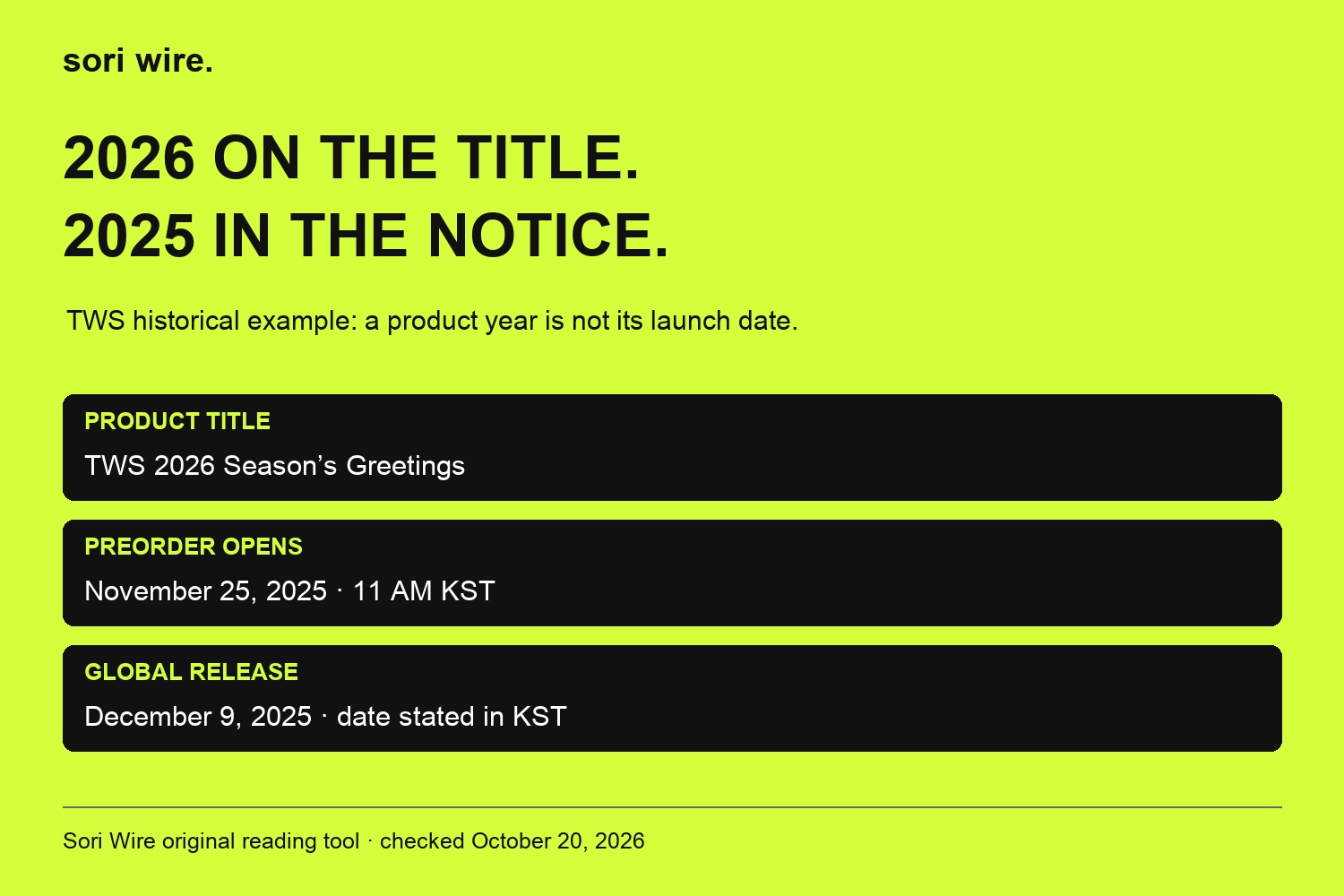
TWS's official 2026 Season’s Greetings notice lists its preorder opening as November 25, 2025 at 11 a.m. KST and its Weverse Global release as December 9, 2025 (KST). This is a useful example of a product title carrying one year while the announced sale milestones fall in the previous year. It is not a conflicting release announcement simply because the numbers differ.
When saving a product, keep its complete title in one field and its sale dates in another. A reminder titled only “2026” does not explain whether you mean the edition, the day ordering opens or the year a calendar is intended for. Our recommendation is to add an action label such as “preorder opens” or “check shipping notice” beside the date you actually want to remember.
Do not generalise this example into an annual release rule. A previous product cannot establish when an artist's next edition will appear. Keep any future title, contents and timing unconfirmed until its own official notice provides them. This guide teaches you how to read the fields that exist, rather than forecasting a holiday-merch calendar from last year's pattern.
A desk calendar is a product component
The same TWS notice includes a desk calendar and a scheduler among its listed contents. Those are physical product components. Their presence is not, by itself, an announcement of the artist's future concerts, appearances or fanclub events. Keep the contents list separate from official activity notices when building your own fan calendar.
That distinction matters when a product photograph or preview shows dates. First establish what the page is describing: an item inside a package, a published event schedule or a sales instruction. If the source only identifies a calendar, our advice is to record it as a calendar component. Do not turn its decorative theme into a claim that the artist plans to visit a particular city or attend an event.
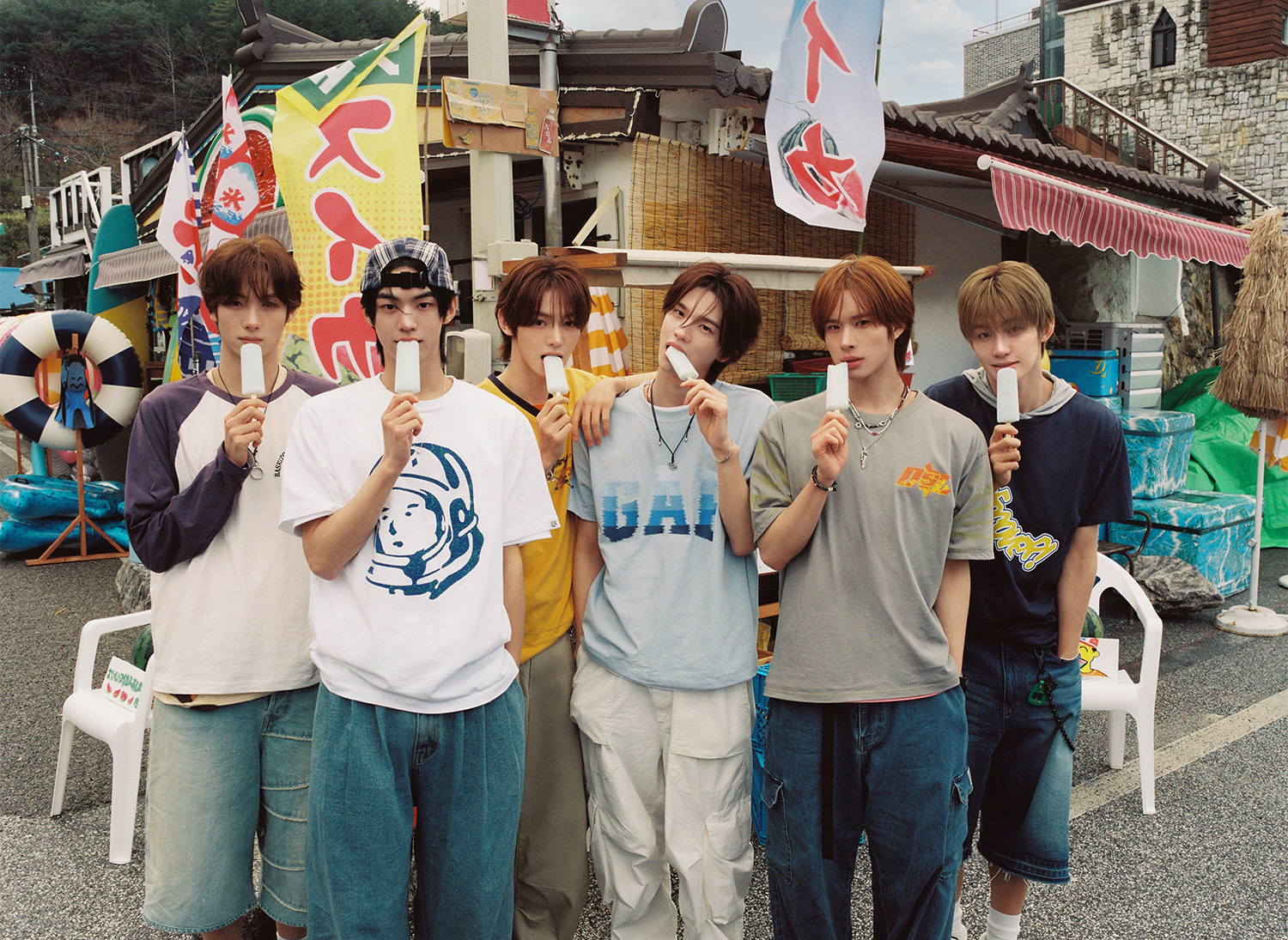
The official TWS group photograph used here is a representative profile illustration, not Season’s Greetings artwork or a picture from a purchaser event. It supplies no information about the package's exact appearance. For those details, use the product's official specifications and previews rather than borrowing a general artist portrait. We have not opened a package or tested the accompanying content.
Write the milestone beside every date
Our reading framework separates five fields: product edition, order opening, order closing if stated, release date and shipping start. Delivery to your address is a further question. These are editorial categories for organising a notice; the seller's exact wording should remain beside them. Do not rename a shipping start as a guaranteed arrival date for the sake of a tidy reminder.
If a purchase period ends when stock runs out, do not invent a fixed closing day. If a notice gives only a date, do not supply a clock from another product. Your record can remain useful with an unresolved field. It is more accurate to say that the source does not establish your delivery day than to attach a confident date to the wrong milestone.
For an overseas purchase, keep the named seller and region attached to the record too. A general release announcement and an individual store's shipping notice may describe different stages of the same product journey. Start with the page relevant to your selected item, then follow its detailed instructions. Do not treat every date found in a search result as an interchangeable answer to “when will I get it?”
A new-year label does not promise January delivery
Weverse Global's historical Red Velvet 2026 Season’s Greetings official-merch notice opened preorders on December 23, 2025 at 3 p.m. KST and said shipping would begin on March 9, 2026 (KST). The notice describes official merch associated with that Season’s Greetings line. We do not use it as the release date for every Red Velvet calendar or for the whole product range.
Read the item scope and the shipping wording together. A year on the title does not override an explicit dispatch plan. If you want something for a particular occasion, compare your plan with the actual seller information before deciding whether to order. This guide does not estimate transit time, customs handling or the delivery performance of the historical sale.
The important distinction is practical: a source can describe a later shipping start without promising when every parcel will arrive. Keep that stage visible in your notes. When another product has a different shipping plan, give it a separate row rather than replacing the original entry with a more appealing date from an unrelated listing. That lets you compare what was stated without accidentally combining two offers.
Calculate a gap without turning it into a delivery estimate
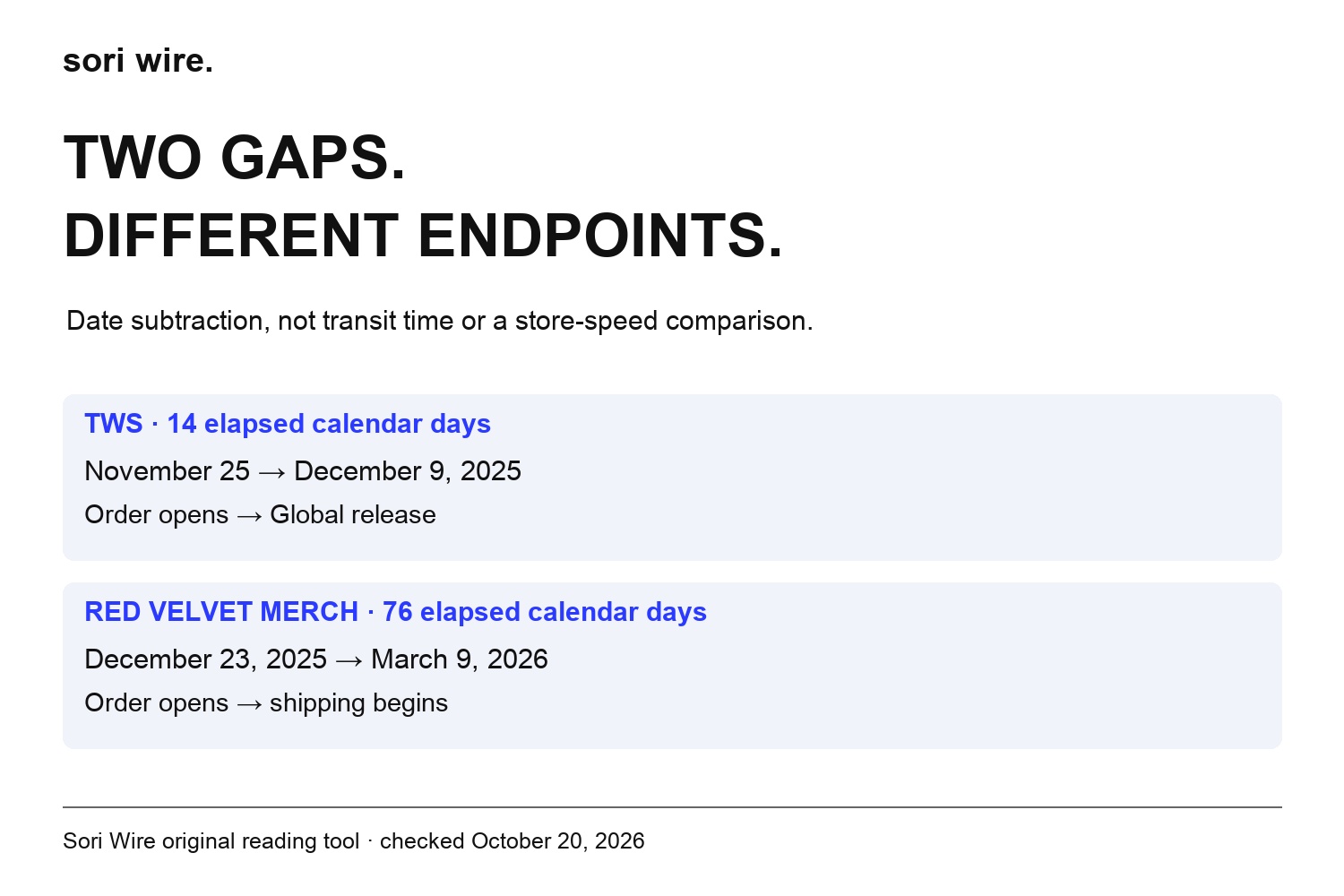
We calculated two date differences using Python's calendar-date subtraction. November 25 to December 9, 2025 is 14 elapsed calendar days. December 23, 2025 to March 9, 2026 is 76. The endpoints are deliberately labelled: the first connects TWS's order opening to its Global release, while the second connects the Red Velvet merch order opening to its announced shipping start.
These are not equivalent logistics measurements. The numbers do not rank the artists or stores, show average delivery times or establish how long a buyer waited. No order was placed for this calculation. We subtract the announced dates to demonstrate why a product title, a release and a shipping milestone should remain separate fields. There is no inclusive countdown or timezone conversion hidden in the arithmetic.
Use that idea cautiously in your own plan. You can measure a clearly defined gap between two dates, but the calculation cannot create information absent from the notice. A release-to-arrival estimate would require different evidence. Label what you calculated, preserve the source dates and leave transit or receipt unresolved when the source does not provide them.
Read the chart as a table
| Historical example | Announced endpoints | Elapsed calendar-date difference |
|---|---|---|
| TWS 2026 Season’s Greetings | November 25 → December 9, 2025; order opens → Global release | 14 days; not a delivery estimate |
| Red Velvet 2026 Season’s Greetings official merch | December 23, 2025 → March 9, 2026; order opens → shipping begins | 76 days; different endpoint, not a speed comparison |
A purchase event can describe a shipped prize
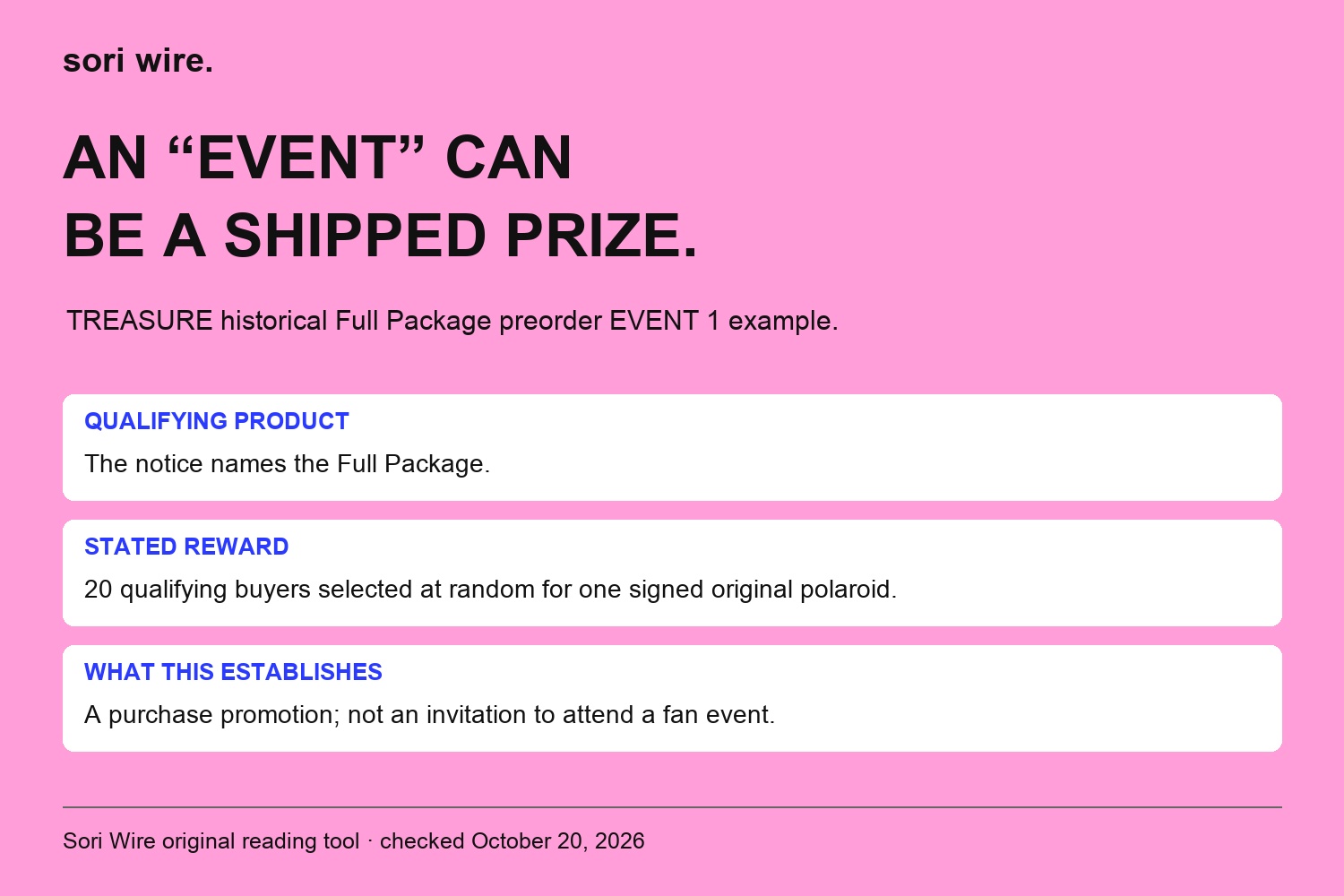
YG's TREASURE 2026 Season’s Greetings notice provides a different kind of example. Under its Full Package preorder EVENT 1, it describes selecting 20 qualifying purchasers at random for an original signed polaroid. It says the prize would be combined with orders shipped after December 29, 2025. That section describes a purchaser reward, rather than giving us an appointment to meet the artist.
The word event should therefore prompt a question: what actually happens to an eligible purchaser? Read the qualifying product, purchase period, selection method and reward. Do not stop at a promotional heading. If the stated result is a shipped item, keep it as a purchase promotion in your notes. A genuine attendance opportunity needs an official explanation that establishes attendance.
This is not a statement that every campaign called an event works the same way. It is a method for reading the particular terms. We have not verified current availability, participant numbers or winners from the historical TREASURE offer. We also do not turn the stated recipient count into a winning probability, because the total pool of qualifying participants is not established here.
Keep the qualifying package attached to the reward
The TREASURE example names the Full Package for the described preorder promotion. The same official announcement also has a Light Package section. Our reading rule is to preserve the exact qualifying option rather than transferring a benefit to every item with the artist and year in its title. Different product names are not harmless details when a condition depends on one of them.
For your own comparison, copy the product option and the benefit statement into the same note. If the listing you are considering does not match, return to the seller's current explanation. Do not rely on a cropped reward image that omits the qualifying package or original dates. A product picture can be attractive while still leaving the conditions you need to check outside the crop.
You do not have to pursue every promotion to enjoy the underlying product. Decide whether you want the actual package before treating a conditional reward as the main reason to purchase. This guide does not recommend a seller, calculate expected value or suggest buying extra copies. The worksheet keeps the conditions visible so that a random extra is not mistaken for a guaranteed inclusion.
Do not repair an unclear date by guessing
When two descriptions appear to disagree, compare the item, seller, region and milestone before comparing the numbers. A product release and a warehouse shipping start are different statements. A notice for an accessory in a Season’s Greetings line may not describe the main package. Your first task is to establish whether the sources are addressing the same thing.
If a timezone label remains unclear, preserve the original wording and seek clarification rather than choosing the clock that seems convenient. In this guide, the TWS calculation uses only the explicitly stated Global release date. We do not convert or reconcile the notice's US release row. That keeps the example within the fields actually needed for the calculation.
Our suggested change log contains the earlier statement, the later statement and the source that explains a change, if one exists. A page failing to load is not a cancellation notice, and a later publication date does not automatically replace an earlier event date. Keep your own unanswered question separate from the artist's or seller's announcement. That distinction makes a shared reminder easier to correct if new information appears.
Keep your shopping calendar apart from your activity calendar
A useful personal setup has two lists. One records product decisions: edition, selected package, order window, seller and shipping information. The other records announced activities: named artist or unit, actual event, date, location and access instructions. These are our organisational suggestions, not two categories imposed by a platform.
Move an item into the activity list only when an official source establishes an activity you can actually attend or watch. A package's digital-content component should be recorded under the relevant product instructions; it does not create an unannounced live appearance. Likewise, a purchaser promotion should retain its selection and reward terms rather than becoming a date you expect to spend with the artist.
Keep the original link in both lists when a notice genuinely connects a product and an event. That allows you to see which statement supports each part of the plan. You can then share a precise summary with a friend without sending a whole product collage and asking them to infer which date matters. The goal is fewer ambiguous reminders, not a larger set of obligations to buy or participate.
The final check is a sentence you can explain
Before saving a reminder, finish this sentence: on this date, this specific thing is announced to happen, according to this source. Use an action such as ordering opens, the product releases or shipping begins. If you cannot finish the sentence without substituting a different milestone, return to the notice and keep the uncertainty visible.
Retain the year when sharing historical examples. A 2026 product discussed in a 2025 notice can otherwise look like a new announcement when the screenshot circulates later. The same applies to a promotion's eligibility period. Its existence in an archive is useful for understanding wording, but does not establish that the offer is still open.
Season’s Greetings can be something you enjoy as a collection, a practical calendar or a gift. You do not need to turn the title year into a delivery promise or a purchase promotion into an artist appearance. Keep the edition, the sale milestones and the actual activity separate. That is the distinction that makes your next product notice easier to read and your personal calendar more dependable.
How this guide was made
Checked October 20, 2026. All sales/promotions are historical examples for 2026-labelled products; no current sale or 2027 product predicted. Red Velvet example concerns the named official-merch sale, not a universal calendar release. Python date differences use different stated endpoints and are not delivery or performance measurements. TWS US row is excluded from conversion/reconciliation because locale wording differs. TREASURE EVENT 1 is a purchaser prize example, not attendance verification or a winning-probability calculation. TWS photograph is unchanged representative official profile material. Three original code-rendered diagrams; no purchase, digital-code redemption, private-content access, firsthand unboxing or media license inferred.