K-pop Tour, Festival or Unit Show? Read the Bill Before You Buy
Separate the event format from the billed act, using official TXT, IRENE & SEULGI and TWICE examples and a practical event card.
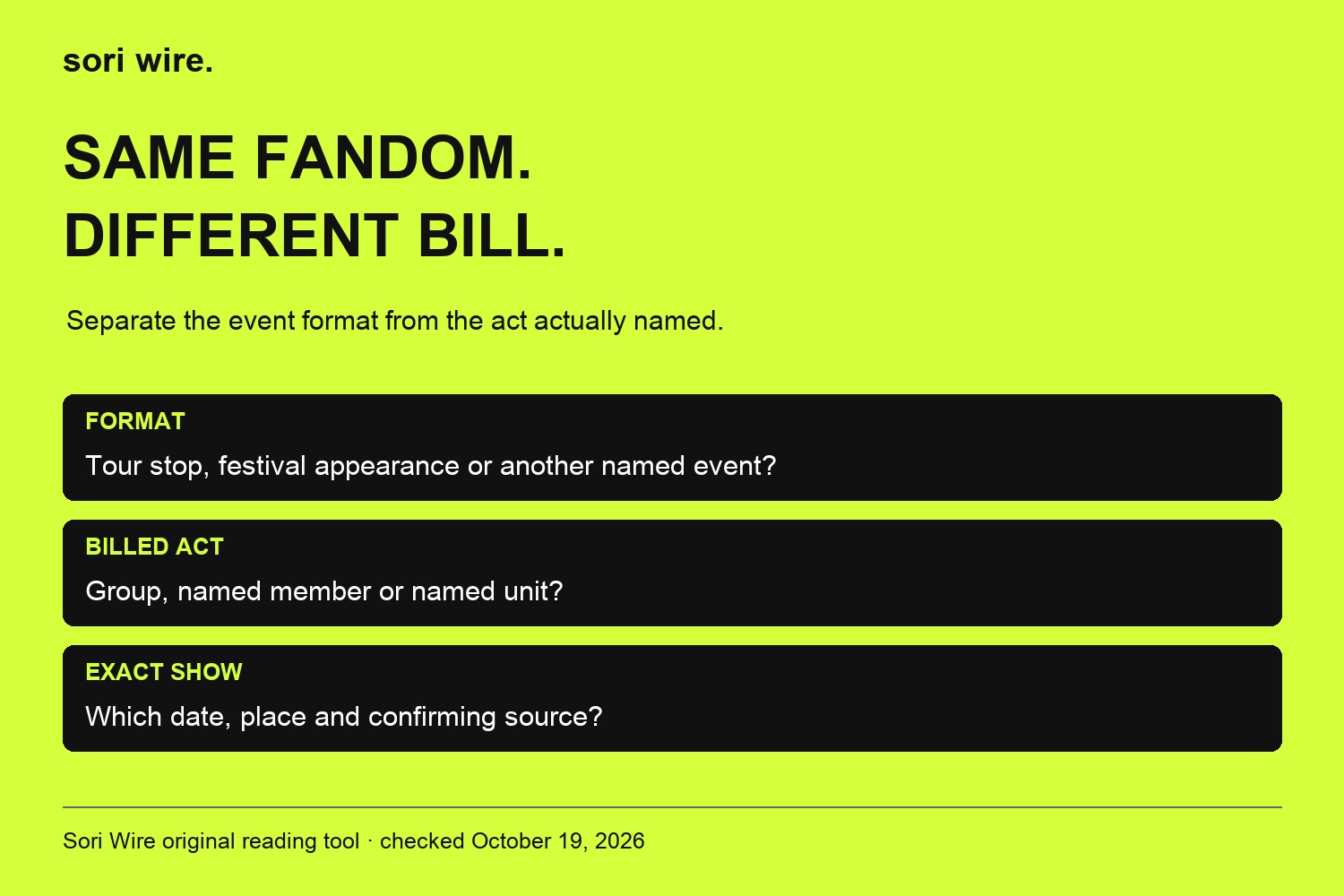
A tour poster, a festival lineup and a two-member concert announcement can all appear in the same group community. They do not promise the same show. Before comparing tickets or asking friends to travel, establish two things separately: the kind of event being announced and the artist name actually on the bill. A group photograph or familiar fanclub name cannot answer both questions for you. This guide uses official 2025 announcements from TXT, IRENE & SEULGI and TWICE as historical reading examples, checked on October 19, 2026. They are not current ticket offers or a report that we attended those shows. Our original comparison graphics and event card help you identify the advertised performer, distinguish a tour stop from a festival appearance, and see which practical details still need the local organiser's notice.
At a glance
- Two fields
- Record event format and the named billed act separately.
- Unit scope
- A group community or profile image does not promise every member onstage.
- Festival scope
- Festival dates, an artist listing and an individual timetable are different fields.
- Examples
- 2025 official announcements are historical reading examples, not current ticket offers.
In this guide
Ask two questions, not one
Start with the exact event title and copy the artist name as written. Then classify the event separately. In our reading framework, the first field describes the format: a concert in a named tour, an appearance at a festival, or another clearly described event. The second describes the billed act: a group, a named individual, or a named unit. These are editorial organising fields, not official ticket categories.
The distinction solves a common misunderstanding. A unit can have a concert tour; unit and tour are not competing choices. A group can appear at a festival without that appearance becoming a stop in its own concert tour. Combining both fields gives you a more useful description than calling everything a group concert. Keep unfamiliar wording from the original title in your note until you can establish what it means.
Your first result should be a sentence you can explain: this notice announces this act in this event format. It should not yet contain a guessed setlist, performance length or complete cast. Those are separate questions. The cover graphic offers a compact starting point; the examples below show how the method works with real official wording.
A named tour stop has a local identity
BIGHIT MUSIC's historical notice names TOMORROW X TOGETHER WORLD TOUR <ACT : TOMORROW> IN SEOUL and lists Gocheok Sky Dome for August 22 and 23, 2025. The city is part of the announced event, not a decorative tag on a worldwide poster. We use those fields to identify the stop; this guide does not investigate its performed setlist or ticket availability today.
When reading a new tour notice, preserve the city and venue beside the tour title. If several dates appear, identify the particular performance you want rather than treating the whole run as one booking. Your ticket comparison begins with that exact show. A benefit, admission method or venue rule copied from a different stop may answer a different question even when the tour branding looks identical.
Our suggested check is to follow the named stop's official information route before planning a purchase. Record the seller and organiser when supplied, and leave a field unresolved when the announcement says details will follow. Do not turn a list of tour cities into a list of already available tickets. The itinerary tells you what has been announced; the relevant local sale tells you how that specific event can be booked.
A unit tour remains the named unit

The official BALANCE Asia schedule is titled for IRENE & SEULGI. Its separate Seoul announcement also names those two artists in the concert title. Those are the performers identified by the notices. Publishing the announcement in Red Velvet's community does not make it a promise that every Red Velvet member is billed for the concert.
Keep the unit name intact when saving or sharing the event. Our recommendation is to use the group as context in a separate field, while leaving the actual event title untouched. That makes a useful distinction for a reader who follows the whole group and for someone specifically interested in the unit. It also avoids implying a lineup change, a departure or a dispute from an ordinary unit announcement.
The official Red Velvet photograph shown here is a representative group illustration. It is not a BALANCE concert photograph and is not evidence of a complete concert cast. This is a useful habit when looking at other articles too: check whether the words establish the performers, rather than asking a general profile image to prove who will appear onstage.
A festival appearance belongs to that festival
JYP's March 19, 2025 announcement identifies TWICE as a headliner for Lollapalooza Chicago. The announcement gives July 31 through August 3 as the festival's overall 2025 dates. That range should not be rewritten as four TWICE performances. We do not use this announcement to supply an individual set time or its duration.
For a festival, separate the festival name, its overall run and the artist's own listing. A poster containing many acts answers a different question from a tour poster dedicated to one act. Read the artist's specific entry and the organiser's corresponding schedule before turning the broad festival dates into your personal plan. If only the full festival range is known from your source, write that limitation clearly.
Do not interpret the word headliner as a guarantee of particular songs, guests, production or minutes onstage. Those details need their own evidence. The useful question for this guide is narrower: which act is announced at which event? You can be excited about a headline appearance while keeping the practical facts attached to the festival rather than borrowing expectations from a separate solo concert tour.
A lineup and a timetable answer different questions
Lollapalooza's official help keeps the questions separate. Its Who is performing page directs readers to the lineup, while its schedule help points to a schedule page. The lineup help currently refers to the 2026 edition. We use that distinction to explain where to look; it does not independently confirm TWICE's historical 2025 set or any artist's present availability.
Our planning method keeps three fields open: whether the act is listed, which date the act is assigned, and which start time is stated. Fill each only from an appropriate official entry. A poster may establish the first field without resolving the other two. This is why a reminder copied from the festival's opening day can be wrong for the artist you actually want to see.
When you have a specific schedule, retain the stage or location name if it is supplied. Do not replace a missing timezone with KST because the performer is Korean. This article does not calculate travel time between stages, tell you when to queue or promise a viewing position. Its contribution is a clear record of what the announcement establishes before you make those separate plans.
Compare the announcement, not an imagined show
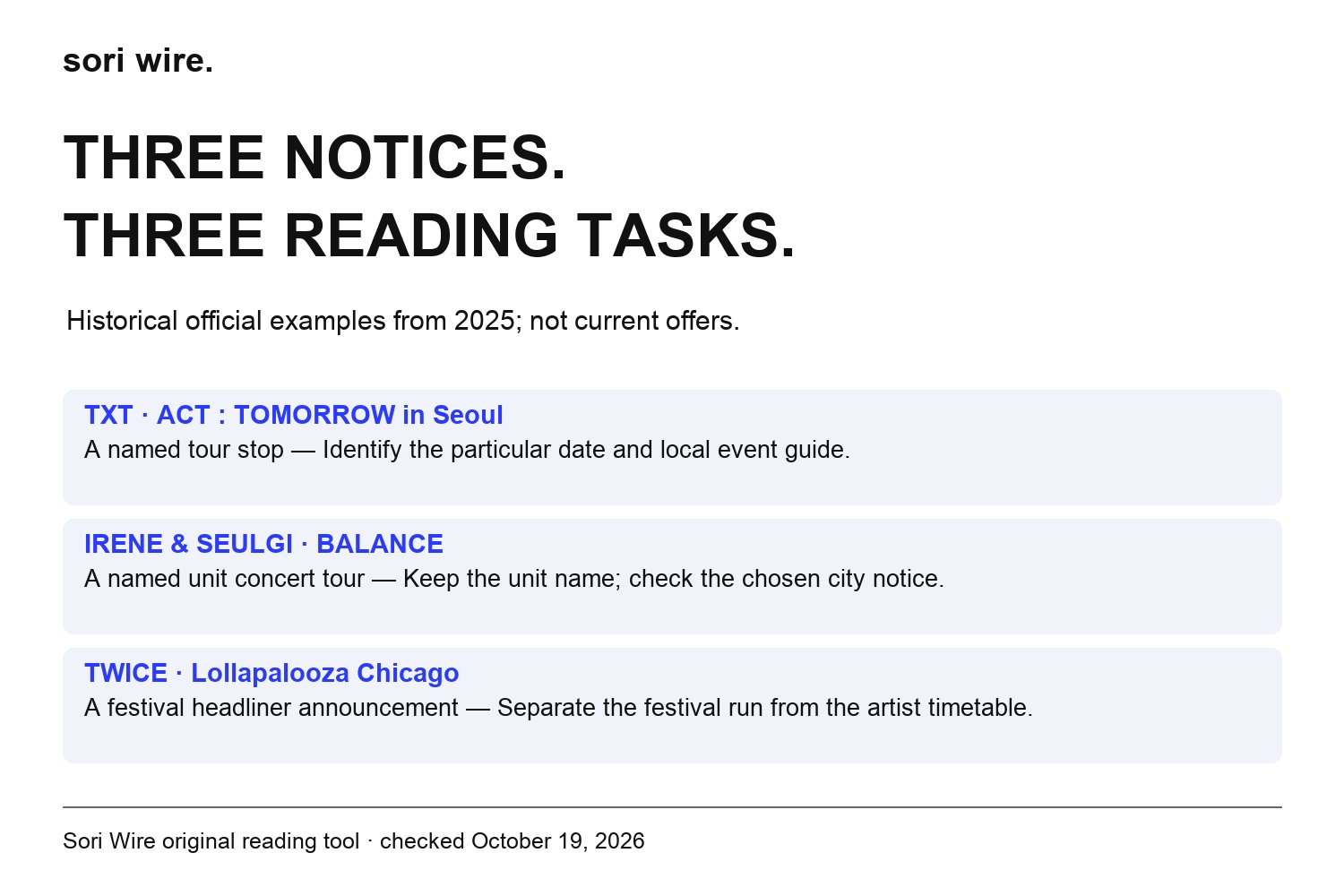
The comparison below deliberately stays small. It contrasts three official announcement types without ranking their entertainment value. A named group tour stop, a named unit tour and an artist's festival billing give you different starting information. None establishes the complete experience simply through its title.
Use the final column to identify the next document you need. You might be looking for a local ticket notice, a specific date's event guide or an artist's festival schedule. These are research tasks for your own chosen show, not claims that an unverified sales page is genuine or that every event follows one booking process. The exact links and conditions should come from the party responsible for that event.
The absence of a detail in this compact comparison does not mean the organiser never published it. It means that we have not used that detail to support this guide. Keeping that distinction visible lets a reader move from a general announcement to the right detailed notice without treating our short summary as the final event manual.
Read the chart as a table
| Official historical example | Billed act / format | What to check next |
|---|---|---|
| ACT : TOMORROW in Seoul (2025) | TXT / named tour stop | Exact date and its local event guide |
| BALANCE Asia schedule (2025) | IRENE & SEULGI / unit concert tour | Named city promoter and ticket notice |
| Lollapalooza Chicago announcement (2025) | TWICE / festival headliner | Artist listing and organiser timetable |
A route announcement is not every city's manual
The BALANCE Asia schedule explicitly says detailed schedules and ticket reservations will be announced by the local promoter and ticket platform. That sentence is useful information. It tells a reader where the tour-wide announcement stops and the local instructions begin. It does not entitle us to invent a single presale rule for the whole route.
For your chosen city, keep a two-part note. The tour schedule establishes the connection to the named tour. The local organiser or seller then supplies the conditions for the specific event. If you can find only the first part, describe the booking details as not yet established in your note. Do not fill the gap with screenshots from another country or a previous tour.
This approach is especially helpful when a friend shares an attractive route poster without the original link. Ask for the confirming announcement and the particular city being discussed. That is a request for usable context, not a reason to question someone else's enthusiasm. Your own plan becomes clearer when its location and source can be named without guessing.
Do not let familiar songs become promised songs
It is natural to imagine which songs an artist might perform. Keep that conversation separate from your factual event card. A unit title does not by itself establish how many songs from the parent group will be included. A tour name does not establish that every city's running order is identical. A headliner announcement does not specify an encore.
Our recommendation is to label an expectation as your own preference whenever the announcement does not support it. If a later official source names a special stage or guest, attach that source to the particular claim. Do not extend the detail to other dates without support. A photograph, a promotional colour or the title of a current album should not silently become a setlist announcement.
For the historical examples in this guide, we compare announcement wording only. We are not reconstructing the concerts or assessing how closely they matched fan expectations. That boundary makes the comparison reusable: you can apply the same fields to a new show without carrying over our examples' dates, ticket terms or an imagined performance programme.
Make one event card before comparing tickets
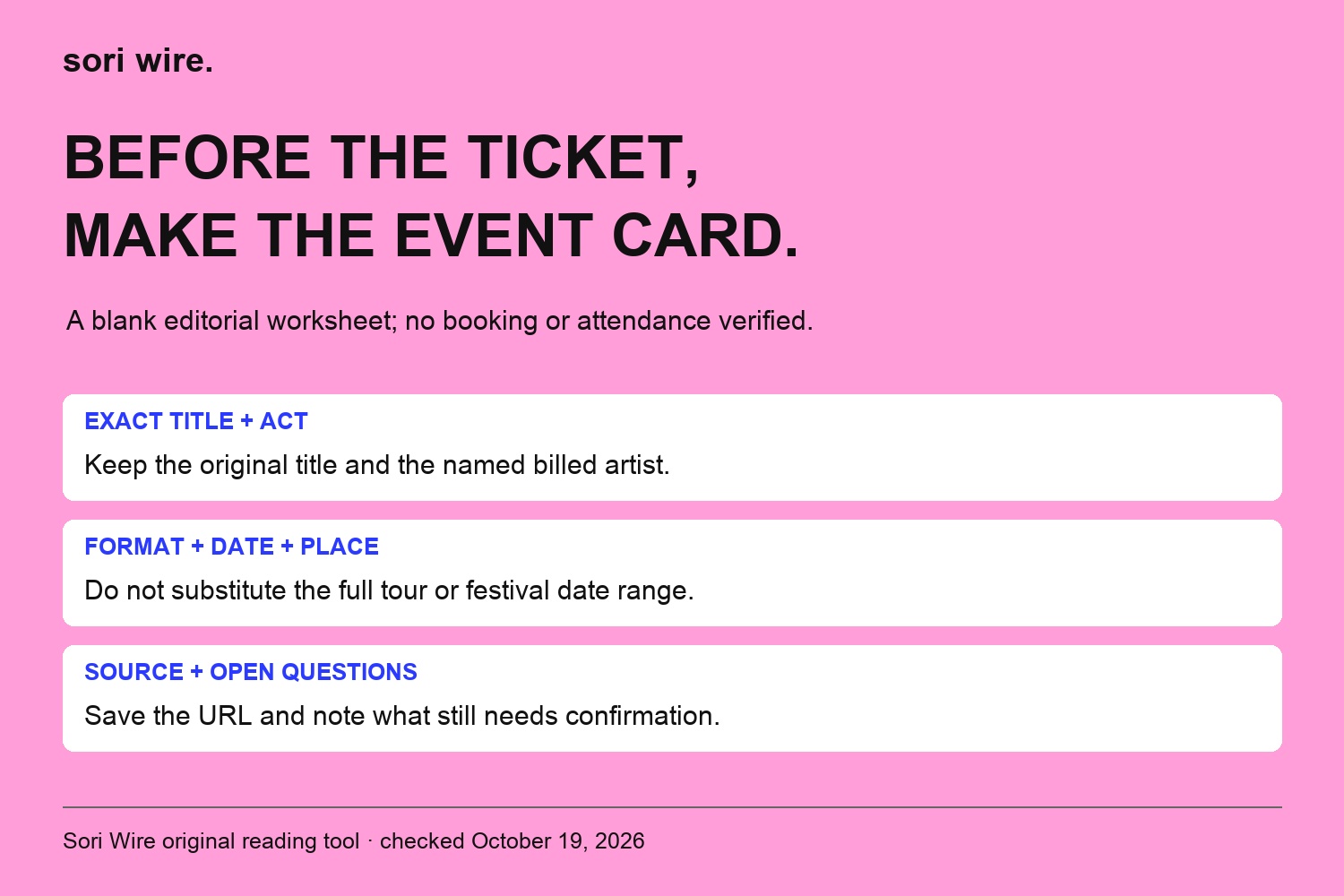
Our event card has six fields: exact event title, billed act, format, specific date and place, confirming URL, and unresolved details. Add the date you checked the source in your own note. This is an original editorial worksheet, not an event organiser's form, and it does not require you to share account details or membership numbers.
Try explaining the card to a friend before looking at prices. They should be able to distinguish the act from its parent group, the particular show from the whole tour, and the artist's appearance from a festival's overall run. If your sentence blurs one of those boundaries, return to the announcement and make the label more precise. A question left open is preferable to a detail borrowed from the wrong event.
Once the event identity is clear, move to the seller's current booking conditions. Our separate presale and ticket-type guides cover those questions. You do not have to solve eligibility, seat choice, travel and the complete artist schedule in the same note. Establishing the correct bill first prevents a very careful purchase comparison from being built around the wrong show.
How this guide was made
Checked October 19, 2026. Official 2025 announcements are historical examples, not attendance verification or current offers. Festival help refers to its 2026 edition, not proof of a 2025 artist timetable. Original diagrams compare announcement scope and provide a blank decision worksheet, not measured concert data. The unchanged official Red Velvet group profile photo is representative, not BALANCE unit performance photography. No member attendance, setlist, performance duration, current tickets, price, timezone conversion, media license or firsthand experience is inferred.